Most of us already have a magnifying glass tucked away somewhere — a drawer, a junk box, maybe an old one from a grandparent. It feels like a relic from another era, especially now that phones can zoom in on anything instantly. And yet, pick one up and look at something ordinary through it, and it’s still kind of magical. A coin, a leaf, the texture of fabric — suddenly there’s detail you never noticed.
The design hasn’t really changed in centuries: a curved piece of glass that bends light just enough to make small things look bigger. No batteries, no apps, no settings to fiddle with. Just glass and curiosity. That simplicity is probably why it’s stuck around for students, collectors, hobbyists, and anyone who just likes looking closely at things.
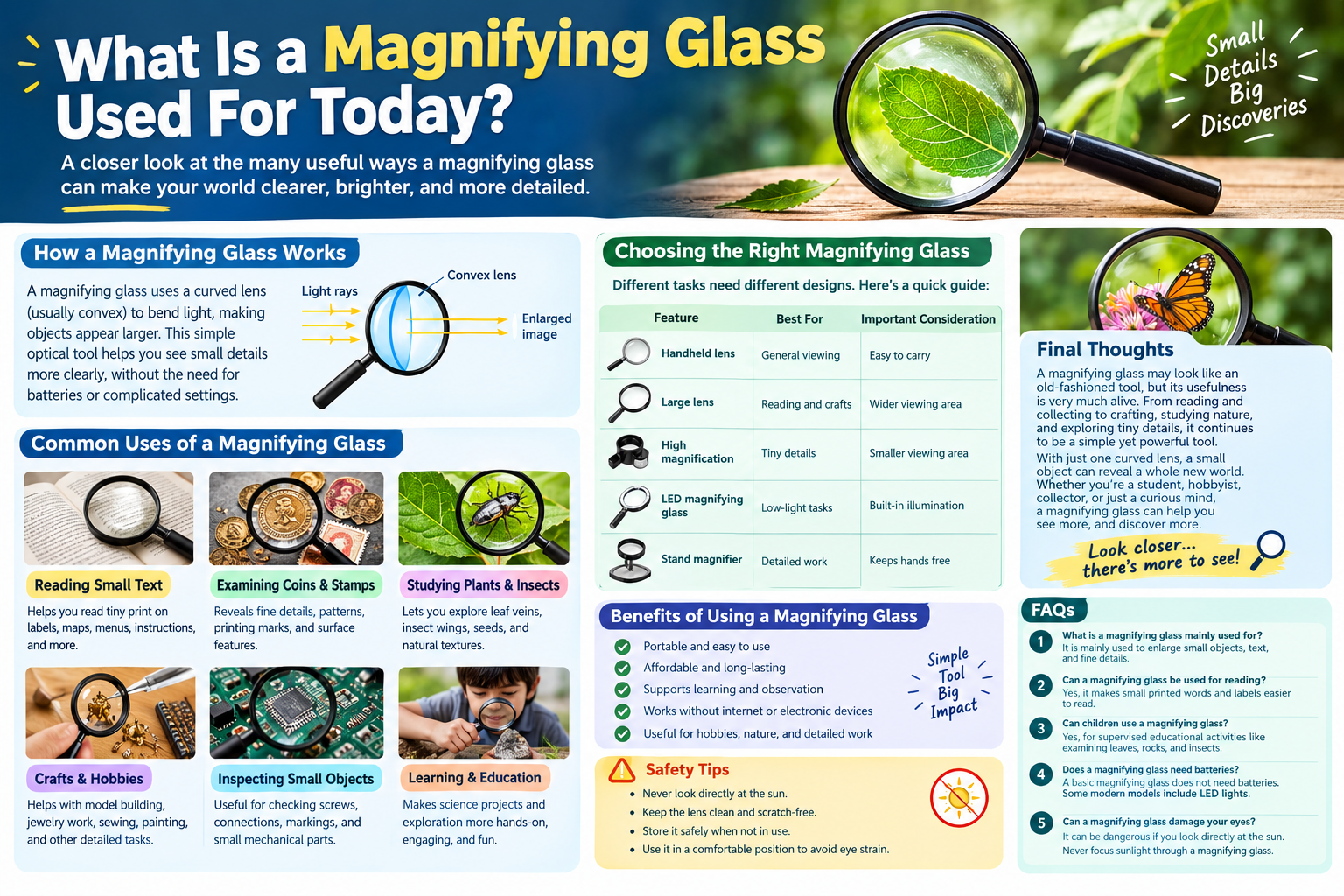
How a Magnifying Glass Actually Works
Inside almost every magnifying glass is a convex lens — curved outward, thicker in the middle than at the edges. That curve bends light in a specific way, and when you hold it at the right distance from something, the object underneath appears larger than it really is.
Why the Lens Shape Matters
How much bigger something looks depends on the lens itself — its curve, its size, how far it sits from your eye. A stronger curve generally means more magnification, but also a smaller area you can actually see clearly at once. It’s a trade-off, and it’s why different magnifying glasses exist for different jobs.
A good lens can reveal details that are basically invisible otherwise — the kind of thing you’d walk right past without a second glance.
Why People Still Reach for One
Part of the appeal is just how little thought it requires. You pick it up, you look, you’re done. No charging, no pairing with Bluetooth, no app to open. In a world full of screens, there’s something almost refreshing about a tool that just works the moment you touch it.
What People Actually Use Magnifying Glasses For Today
A magnifying glass still earns its place in a lot of everyday situations — some practical, some just for fun.
Reading Small Print
This is probably the most common use, honestly. Tiny text on medicine bottles, maps, menus, or old letters becomes a lot easier to deal with when you’re not squinting. It helps even more when the print is faint or the contrast is poor.
Looking at Coins and Stamps
Collectors lean on magnifying glasses constantly. Tiny engravings, mint marks, printing quirks, and surface wear are often invisible to the naked eye but obvious once magnified. For a lot of collectors, that’s honestly half the fun — finding a detail nobody else noticed.
Exploring Plants and Insects
Gardeners, students, and anyone curious about nature can get a lot out of examining leaves, seeds, flowers, or insects up close. Veins on a leaf, the texture of a wing, the pattern on a petal — it turns a backyard walk into something closer to a tiny expedition.
Crafts and Detail Work
Hobbies like model building, jewelry making, miniature painting, and embroidery all reward a closer look. A magnifying glass takes the strain off your eyes and makes fiddly, delicate work a lot more manageable.
Checking Small Objects and Parts
Tiny screws, hairline scratches, faint markings, and small components are all easier to spot under magnification. It’s not a substitute for proper inspection equipment, but as a quick first look, it does the job well.
Magnifying Glasses in Learning
There’s something different about actually seeing a thing up close versus just reading about it. A magnifying glass turns a passive lesson into something hands-on.
Science Class, the Simple Way
Kids examining soil, rocks, leaves, or bugs under a magnifying glass tend to remember it a lot better than if they’d just read a paragraph about it. It’s a small tool, but it makes the lesson stick.
Everyday Objects, Totally Transformed
Even something as plain as a coin or a scrap of fabric can look completely different magnified. That little shift in perspective is genuinely good at building observation skills, especially in kids who haven’t thought to look that closely before.
Picking the Right One
Not every magnifying glass is built for the same job, so it’s worth thinking about what you’ll actually use it for.
| Feature | Best For | Worth Knowing |
| Handheld lens | General, everyday viewing | Easy to carry around |
| Large lens | Reading and crafts | Wider view, less strain |
| High magnification | Tiny, fine details | Smaller field of view |
| LED magnifying glass | Low-light situations | Needs a battery |
| Stand magnifier | Detailed, hands-free work | Keeps both hands free |
| Pocket/folding magnifier | On-the-go use | Compact and protected lens |
| Dome magnifier | Reading flat documents | Rests directly on the page |
| Jeweler’s loupe | Very close inspection | Worn near the eye for precision |
The right pick really just depends on the task. A bigger lens is more comfortable for reading over long stretches, while a smaller, stronger one suits something like inspecting a tiny engraving.
Why It’s Still Worth Having One
A magnifying glass is cheap, portable, and dead simple to use — no learning curve at all. For anyone into collecting, crafting, gardening, or just general curiosity, it ends up being more useful than you’d expect.
It also works completely offline, no electricity or signal required, which honestly makes it one of the more reliable tools in a junk drawer.
A Quick Safety Note
Using one is about as simple as it gets, but there’s one real rule: never point a magnifying glass at the sun and look through it, and definitely never let sunlight focus through the lens toward your eyes. Concentrated light like that can cause real, fast eye damage.
Otherwise, just keep the lens clean, store it somewhere it won’t get scratched, and hold your work at a comfortable distance so you’re not straining your eyes during longer sessions.
Frequently Asked Questions
What is a magnifying glass mainly used for?
Mostly for making small objects, text, and fine details easier to see.
Can a magnifying glass help with reading?
Yes — it makes small print, labels, and instructions much easier to read, especially when text is faint or tiny.
Can kids use a magnifying glass?
Yes, with a bit of supervision — it’s great for examining leaves, rocks, insects, and other simple nature finds.
Does a magnifying glass need batteries?
A basic one doesn’t. Some modern versions with built-in LED lights do.
Can a magnifying glass hurt your eyes?
Only if it’s pointed at the sun — never look through one at direct sunlight, since the concentrated light can seriously damage your eyes.
Final Thoughts
A magnifying glass might look a little old-fashioned sitting next to a smartphone, but it hasn’t actually lost much relevance. It still helps with reading, collecting, learning, crafting, and just looking closely at the world in general.
Its real strength has always been how little it asks of you. One curved piece of glass, and suddenly a small, overlooked object turns into something worth a second look. Whether you’re a student, a collector, someone who likes tinkering with crafts, or just naturally curious, it’s a small tool that still earns its spot in the drawer.