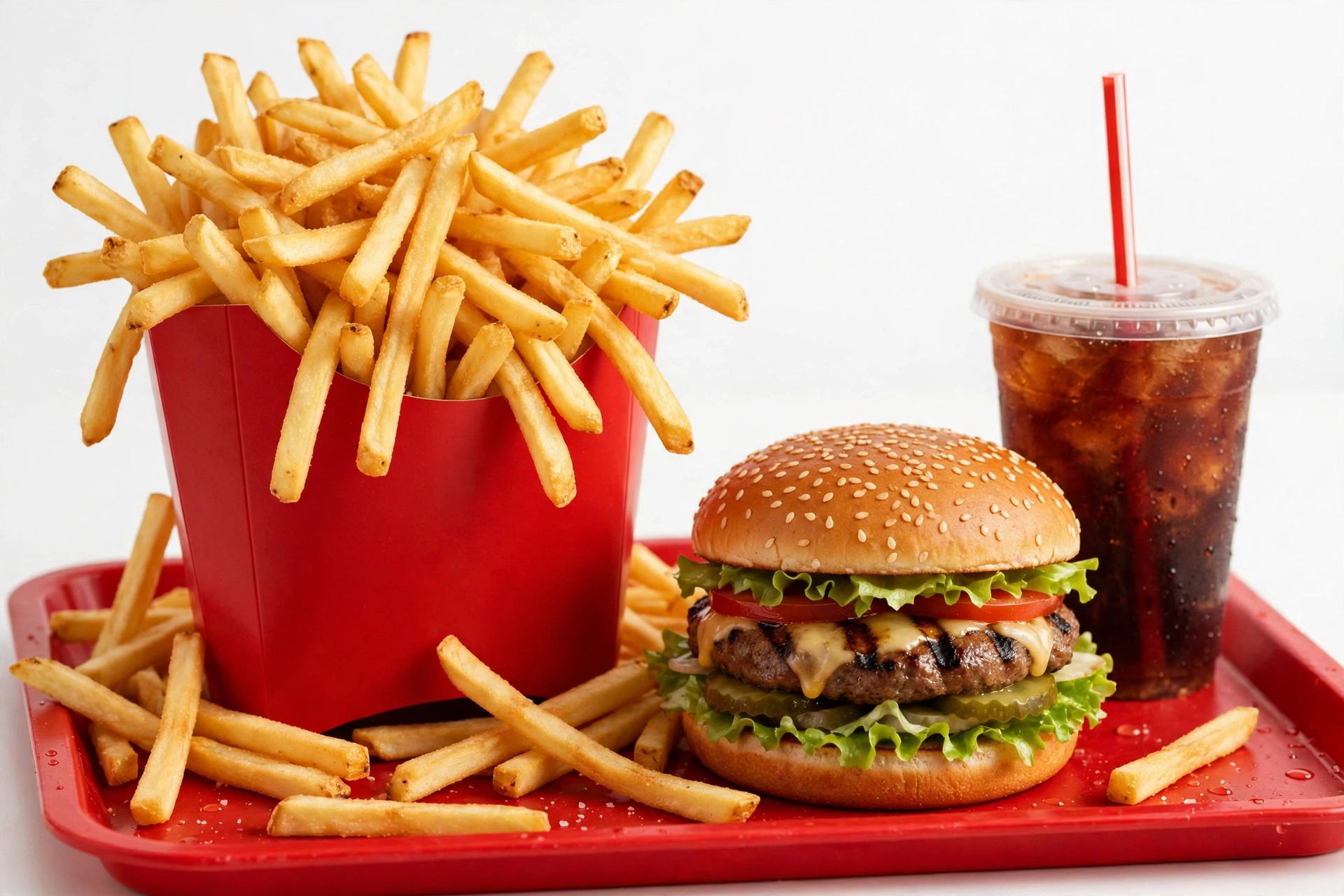
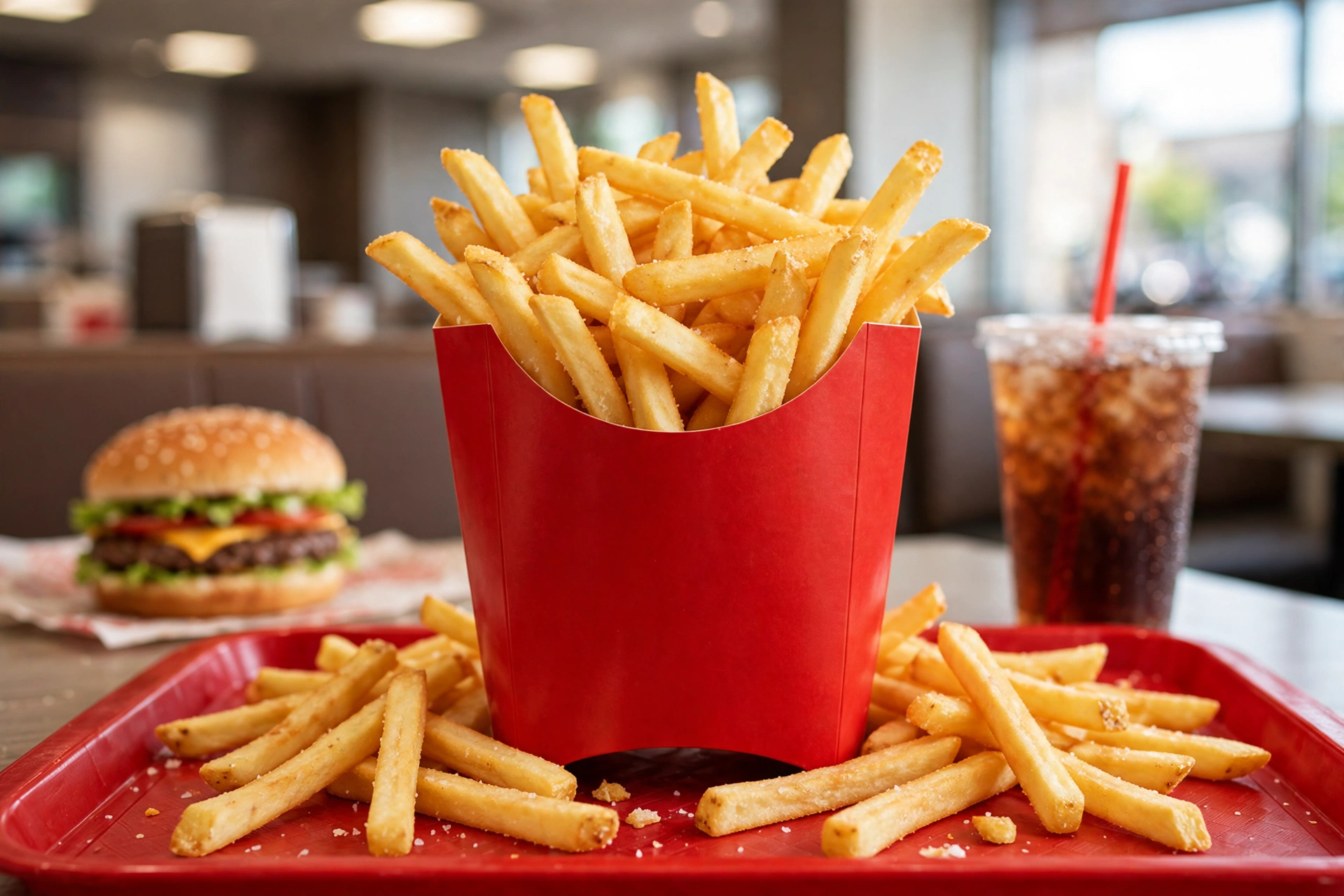
Burger King large fries are the biggest carton of fries on the Burger King menu — 440 calories of thick-cut, salted fries in a large red carton, and the size most people actually want when they order a meal. The catch is the price: Burger King is franchised, and bk.com publishes no national price list, so the large fries cost a different amount at nearly every restaurant. This guide gives you the reported November 2026 price range, the official calorie and nutrition numbers for every size, what is actually in the fries, and how the meal upgrade works — so you can decide whether the large is worth it before you order.
One note before the prices. Every dollar figure in this article is a reported range from independent menu trackers that read real bk.com restaurant menus in October and November 2026 — reported at some locations, varies, confirm locally in the BK app before you order. Where sources disagree, this guide says so instead of picking one number and pretending it is official. The calorie figures, on the other hand, are Burger King’s own published US nutrition numbers, and they do not vary by location.
The quick answer: A Burger King large fries costs about $3.49 to $4.29 in the US in November 2026, with most locations charging around $3.79 to $4.19, and it carries 440 calories, 20 g of fat and 400 mg of sodium. The medium is 370 calories for about $3.19 to $3.89, the small is 300 calories for about $2.49 to $3.59, and the value fries are 230 calories for about $2.19 to $2.59. Check the BK app for your restaurant’s exact price.
How Much Are Burger King Large Fries?
A large fries at Burger King typically costs about $3.79 to $4.19, in a reported range from about $3.49 to $4.29. That is the honest answer, and it is a range rather than a single price because the sources do not agree on one number — and neither do the restaurants.
One menu tracker that read the bk.com menus of 50 US restaurants in November 2026 puts the typical fries price at $3.59, with a range running from $2.59 to $5.09 across sizes. Another guide updated in September 2026 lists the large at $4.19, with the value at $2.59, the small at $3.59 and the medium at $3.89. A third guide lists the large at $3.79, with the value at $2.19, the small at $3.19 and the medium at $3.49. A fourth puts the large at $3.49, with the small at $2.49 and the medium at $3.19. And a fifth, comparing the three big chains in October 2026, puts Burger King’s large fries at about $3.49.
The pattern underneath the disagreement is consistent: the large costs roughly $1 to $1.50 more than the small, and roughly 50 to 70 cents more than the medium. The cheapest large fries are found in the Midwest and the South, and the most expensive in Hawaii, California and the Northeast, where a large can cost over $4.50. A same-day price index covering 6,363 US Burger King restaurants put the small fries at a typical $2.99 on 17 November 2026, in a range from $2.15 to $4.59 — which tells you how wide the spread is even for the smallest size.
The practical advice is simple: open the BK app, pick your restaurant, and look at the price before you order. The app shows the exact price for that location, and it is the only place the price is guaranteed. The numbers in this guide are for planning, not for arguing at the counter.
Burger King Fries Sizes: The Full Price and Calorie Table
Burger King sells its fries in four sizes: value, small, medium and large. The value fries are the smallest carton — the one that comes with the $1 Your Way menu and the $5 Your Way Meal. The small is the size that comes standard with most combo meals. The medium is the middle step. The large is the biggest carton on the menu.
The calorie numbers below are Burger King’s official US nutrition figures, confirmed by several independent trackers that read bk.com’s nutrition explorer in October and November 2026. The prices are reported November 2026 ranges, and they are the part that varies.
| Fry size | Reported price (Nov 2026) | Typical price | Calories | Fat | Sodium |
|---|---|---|---|---|---|
| Value | about $2.19 – $2.59 | about $2.19 – $2.59 | 230 | 10 g | 200 mg |
| Small | about $2.49 – $3.59 | about $2.99 | 300 | 13 g | 270 mg |
| Medium | about $3.19 – $3.89 | about $3.49 – $3.59 | 370 | 17 g | 330 mg |
| Large | about $3.49 – $4.29 | about $3.79 – $4.19 | 440 | 20 g | 400 mg |
Two things stand out in that table. First, the step from small to medium costs more, in calories and in money, than the step from medium to large. Going from small to medium adds 70 calories and roughly 50 cents. Going from medium to large adds another 70 calories and roughly 30 to 50 cents. The large is the best value per calorie of the four sizes — it nearly doubles the value fries for roughly double the price, and it costs only a little more than the medium for a noticeably bigger carton.
Second, the old calorie numbers you may remember from a few years ago are higher than the current ones. Older guides list a small fries at 320 calories, a medium at 380 to 400, and a large at 430 to 500. Burger King’s current published figures are 300, 370 and 440. The older numbers are stale, and the USDA-based figures of 207 for a small, 328 for a medium and 448 for a large come from a generic fast-food fries entry, not from Burger King’s own nutrition data. This guide uses Burger King’s own numbers: 230, 300, 370 and 440.
How Much Is a Small Fry at Burger King?
A small fries at Burger King costs about $2.49 to $3.59 in the US in November 2026, with a typical price of about $2.99. That typical figure comes from a same-day index of 6,363 US Burger King restaurants on 17 November 2026, which found small fries ranging from $2.15 in Arcadia, Louisiana to $4.59 at the most expensive locations, with Oklahoma the cheapest state at a typical $2.49 and Hawaii the most expensive at a typical $4.19.
Other guides give lower numbers. One lists the small at $2.79. Another lists it at $2.49. Another, updated in September 2026, lists it at $3.59. The spread is real, and it is the same franchise-pricing story as the large: your state and your city matter more than any national average. In most of the Midwest and the South, expect about $2.49 to $2.99 for a small. On the coasts and in Hawaii, expect $3.49 or more.
The small fries carry 300 calories, 13 g of fat, 40 g of carbohydrate, 4 g of protein and 270 mg of sodium, according to Burger King’s published nutrition data. It is the size that comes with most combo meals by default, so it is also the size most people eat without ever choosing it. If you are watching calories, the small is the sensible default — 140 fewer calories than the large for a saving of roughly a dollar.
How Much Is a Medium Fry at Burger King?
A medium fries at Burger King costs about $3.19 to $3.89 in the US in November 2026, with a typical price of about $3.49 to $3.59. One guide lists the medium at $3.89, another at $3.49, a third at $3.19. The 50-restaurant November reading that put the typical fries price at $3.59 was most likely reading the medium, since the medium is the standard carton on the sides menu.
The medium carries 370 calories, 17 g of fat, 50 g of carbohydrate, 5 g of protein and 330 mg of sodium. It is the middle of the ladder in every sense: 70 calories more than the small, 70 fewer than the large. For most people ordering a la carte, the medium is the awkward size — it costs nearly as much as the large for noticeably less food. The large is usually the better buy if you want a lot of fries, and the small is the better buy if you want to keep the calories down. The medium makes the most sense inside a combo meal, where it is the default upgrade size.
How Much Are Fries at Burger King?
Put together, Burger King fries cost about $2.19 to $4.29 a la carte in the US in November 2026, depending on the size. The value fries are about $2.19 to $2.59. The small is about $2.49 to $3.59. The medium is about $3.19 to $3.89. The large is about $3.49 to $4.29. All prices are reported ranges from independent menu trackers, not official prices, and they vary by location because Burger King is franchised.
There are cheaper ways to get fries than buying them a la carte. The value fries are part of the $1 Your Way menu, listed at $1 at participating restaurants — though many locations charge $1.59 to $1.89 at the counter, and the dollar price is most reliable in the app. Fries also come free, or nearly free, in the app: Royal Perks regularly runs free fries with a small purchase, and the $5 Your Way Meal includes fries with a sandwich, nuggets and a drink for about $5. Our BK value menu guide covers those deals in full, and our BK menu guide covers the whole lineup.
Delivery is the most expensive way to buy fries. Delivery apps add their own markup on top of the restaurant price, plus fees, so a large fries that costs $3.79 at the counter can cost over $5 delivered. If you are ordering delivery, the combo meal is usually better value than a la carte fries, because the delivery markup applies once to the whole meal instead of once to each item.
What’s in Burger King Fries?
Burger King fries are made from potatoes, vegetable oil (soybean oil and/or canola and/or palm oil), modified potato starch, rice flour, potato dextrin, salt, leavening (disodium dihydrogen pyrophosphate and sodium bicarbonate), dextrose, xanthan gum and sodium acid pyrophosphate to preserve the natural color. They are cooked in vegetable oil (corn, canola, soy and/or cottonseed).
Two things about that ingredient list are worth knowing. First, the coating is rice flour and potato starch, not wheat flour — which is unusual for fast-food fries, and is why the fries themselves contain no wheat ingredient. Second, Burger King makes no gluten-free claim for its fries, and you should not treat them as gluten-free. The fries are cooked in oil shared with breaded chicken, fish and onion rings, so cross-contact with wheat is a real risk, and Burger King’s own allergen information warns that fried items may be cooked in the same oil as wheat-containing items. People with celiac disease or a severe gluten sensitivity should not rely on the fries being gluten-free.
The fries do contain soy, from the soybean oil. They contain no milk, egg, peanut, tree nut, fish or shellfish as ingredients — though the shared fryer means fish cross-contact is possible, since the Big Fish filet is fried in the same oil. If you have a food allergy, check Burger King’s allergen guide for your restaurant, and tell the crew before you order. Our Burger King allergen guide covers the full menu.
Nutritionally, the fries are what you would expect: mostly carbohydrate and fat, with very little protein. A large fries has 60 g of carbohydrate, 20 g of fat and 6 g of protein, with 400 mg of sodium — about 17% of the recommended daily sodium limit. The value fries, at 230 calories and 200 mg of sodium, are the lightest option on the sides menu by a clear margin.
How the Meal Upgrade Works
Most Burger King sandwiches can be made into a meal, which adds fries and a drink. The standard meal comes with a small fries and a small drink. Upgrading the fries to a medium or a large costs extra, and the upgrade charge is where the large fries become a genuinely good deal.
Here is how it works in practice. A Whopper on its own costs about $5.89 to $7.59. A Whopper meal with medium fries and a medium drink costs about $8.99 to $11.49. The meal adds roughly $3 to $3.90 to the sandwich price, and that buys you a medium fries and a medium drink. Upgrading the meal’s fries from medium to large typically costs about $0.50 to $1.00 extra, and upgrading the drink to a large costs a similar amount. So a large fries inside a meal costs you far less than a large fries bought on its own — roughly a dollar instead of roughly four.
That is the key point about the large fries: bought a la carte, it is the most expensive side on the menu. Bought as a meal upgrade, it is the cheapest way to get a large portion of anything at Burger King. If you are already ordering a meal, the upgrade to large fries is almost always worth it. If you are ordering a la carte, the value fries or the small are better value for money.
One more detail: the meal upgrade price is not the same at every restaurant, and it is not always shown on the board. Some restaurants charge $0.50 for the large upgrade, some charge $1.00, and some build the large into the meal price with no separate charge at all. The BK app shows the upgrade price for your restaurant before you check out, so build the meal in the app and compare the total before you pay.
For the full meal prices, including the Whopper meal and the Whopper Jr. meal, see our guide to how much a Whopper meal costs and our King Meal guide.
Large Fries vs Onion Rings and Other Sides
The large fries are not the only side at Burger King, and they are not the cheapest per calorie. Onion rings come in the same four sizes, and at every size they carry fewer calories than the matching fries: value onion rings are 170 calories against 230 for the fries, small rings are 230 against 300, medium rings are 290 against 370, and large rings are 430 against 440. The large rings are nearly identical in calories to the large fries, but the smaller ring sizes are noticeably lighter.
Mozzarella fries are the other fried side, at about 220 calories for a 4-piece order and about $3.99 typical. Chicken fries are a different kind of side altogether — 110 calories for a 4-piece, about $4.39 typical — and they come with a dipping sauce. And the Have-sies, half fries and half onion rings, run 220 calories for the value size and 350 for the medium, at a typical $3.59.
For dipping, the fries pair with any of Burger King’s sauces, and the most popular choices are ketchup, BBQ and ranch. Our guide to what sauces Burger King has covers the full sauce list, the prices, and which sauces are free with nuggets and chicken fries.
The bottom line on sides is that the large fries are the biggest, most filling side Burger King sells, and the best value per calorie in the large size. But they are also the heaviest single side on the menu. If you want the most food for the money, order the large. If you want the lightest side, order the value fries or the value onion rings. If you want something in between, the small fries are the default for a reason.
Is the Large Fries Worth It?
It depends on how you are ordering. As a meal upgrade, yes — the large fries are the best value on the Burger King menu, because the upgrade costs roughly $0.50 to $1.00 on top of a meal that already includes fries. As an a la carte order, the value is thinner: about $3.79 to $4.19 for 440 calories, when the value fries give you 230 calories for about $2.19 to $2.59. You pay nearly double for less than double the food.
The comparison with the other chains is also worth making. McDonald’s large fries cost about $3.19 in October 2026, and Wendy’s large fries cost about $3.49 — both a little cheaper than Burger King’s large, and both a little smaller in calories. Burger King’s large is the biggest of the three, and the most expensive. If price is the only thing that matters, McDonald’s wins. If portion size is the only thing that matters, Burger King wins.
For most people, the right order is the medium fries in a meal, upgraded to large if the upgrade is under a dollar, or the value fries a la carte if you just want a snack. The large fries are for the days when you are genuinely hungry, or when you are sharing. Two people splitting a large fries and a sandwich is a better lunch than one person eating a large fries alone — and it costs less than two mediums.
Frequently Asked Questions About Burger King Large Fries
How much is a Burger King large fries?
A Burger King large fries costs about $3.49 to $4.29 in the US in November 2026, with most locations charging around $3.79 to $4.19. Prices are reported ranges from independent menu trackers, not official prices, and they vary by location because Burger King is franchised. Check the BK app for your restaurant’s exact price.
How many calories are in Burger King large fries?
A Burger King large fries has 440 calories, with 20 g of fat, 60 g of carbohydrate, 6 g of protein and 400 mg of sodium, according to Burger King’s published US nutrition data. That is nearly double the 230 calories in the value fries, and 70 calories more than the 370 in the medium.
How much is a small fry at Burger King?
A small fries at Burger King costs about $2.49 to $3.59 in the US in November 2026, with a typical price of about $2.99 based on a same-day index of 6,363 US Burger King restaurants on 17 November 2026. It carries 300 calories, 13 g of fat and 270 mg of sodium.
How much is a medium fry at Burger King?
A medium fries at Burger King costs about $3.19 to $3.89 in the US in November 2026, with a typical price of about $3.49 to $3.59. It carries 370 calories, 17 g of fat, 50 g of carbohydrate and 330 mg of sodium.
How much are fries at Burger King?
Burger King fries cost about $2.19 to $4.29 a la carte in the US in November 2026, depending on size: value about $2.19 to $2.59, small about $2.49 to $3.59, medium about $3.19 to $3.89, and large about $3.49 to $4.29. All prices are reported ranges and vary by location. The cheapest way to get fries is in a meal or through the BK app, where free-fries offers run regularly.
What sizes do Burger King fries come in?
Burger King fries come in four sizes: value (230 calories), small (300 calories), medium (370 calories) and large (440 calories). The value fries are the smallest carton and come with the $1 Your Way menu and the $5 Your Way Meal. The small is the default size in most combo meals. The large is the biggest carton on the menu.
Are Burger King fries gluten-free?
No. Burger King makes no gluten-free claim for its fries. The fries themselves contain no wheat ingredient — the coating is rice flour and potato starch — but they are cooked in oil shared with breaded chicken, fish and onion rings, so cross-contact with wheat is a real risk. People with celiac disease or a severe gluten sensitivity should not treat Burger King fries as gluten-free.
What is in Burger King fries?
Burger King fries are made from potatoes, vegetable oil (soybean oil and/or canola and/or palm oil), modified potato starch, rice flour, potato dextrin, salt, leavening, dextrose, xanthan gum and sodium acid pyrophosphate, and are cooked in vegetable oil. They contain soy from the soybean oil, and Burger King warns they may be cooked in the same oil as wheat-containing items.
How much does it cost to upgrade to large fries in a meal?
Upgrading the fries in a Burger King meal from medium to large typically costs about $0.50 to $1.00 extra, though the charge varies by restaurant and is not always shown on the board. A standard meal comes with small fries and a small drink; the medium fries and medium drink are the usual meal size, and the large upgrade is charged on top of that. The BK app shows the exact upgrade price for your restaurant.
Which Burger King fry size is the best value?
As a meal upgrade, the large fries are the best value — the upgrade costs roughly $0.50 to $1.00 for 70 extra calories over the medium. Bought a la carte, the value fries are the best value per dollar, at about $2.19 to $2.59 for 230 calories, and the large is the best value per calorie among the full sizes. The medium is the weakest value a la carte, since it costs nearly as much as the large for noticeably less food.