
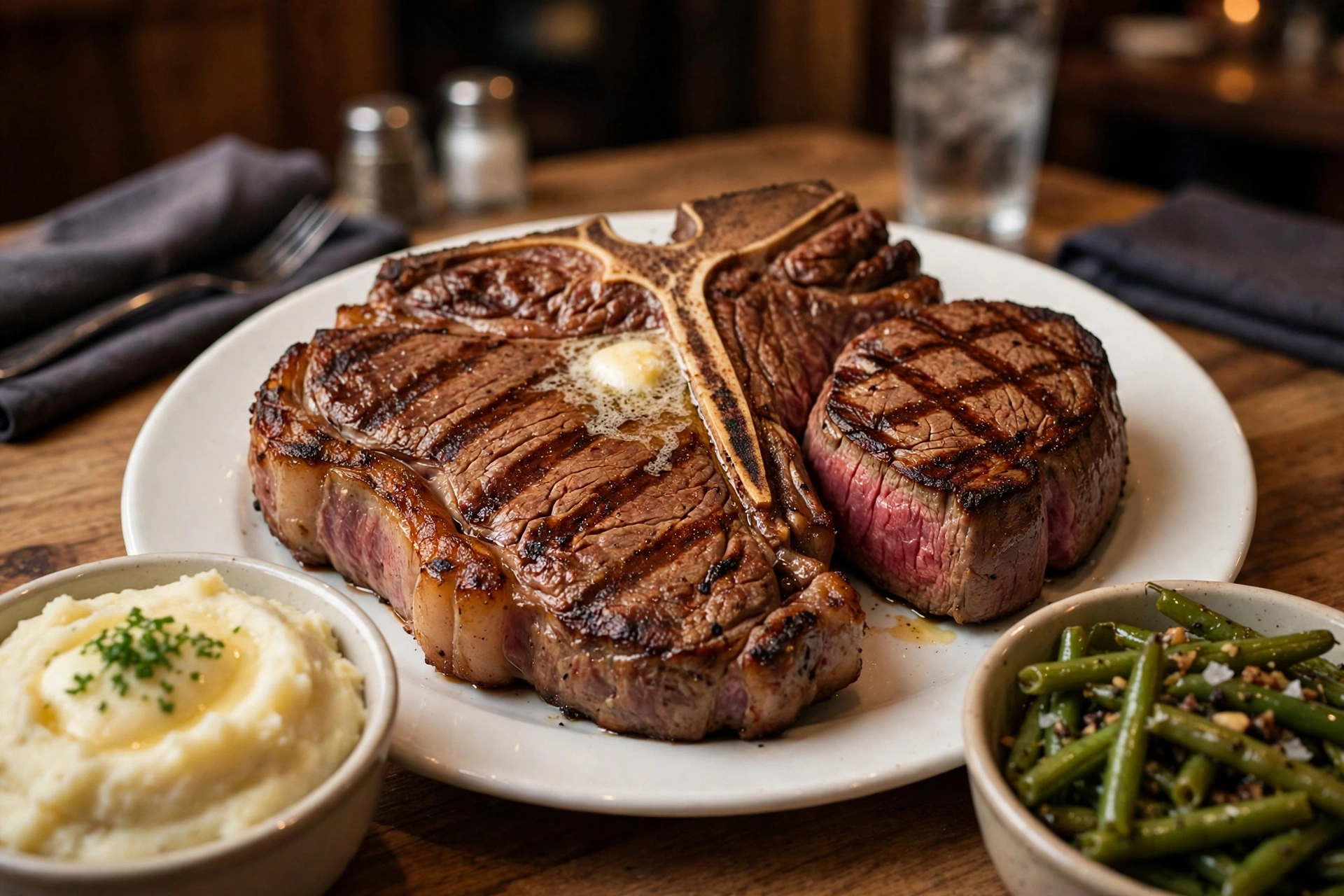
If you want the biggest steak on the Texas Roadhouse menu, there is only one answer. The porterhouse steak Texas Roadhouse serves is listed as the Porterhouse T-Bone, a 23 oz bone-in steak that puts a New York strip on one side of the bone and a filet on the other. It is the largest steak the chain sells, the most expensive steak on the menu, and one of the most argued-about steaks the chain has ever served.
That argument is the interesting part. One major ranking named the Porterhouse T-Bone the single best steak at Texas Roadhouse. A Texas Roadhouse employee on Reddit called it the one steak on the menu they would not recommend. Both sides have a point, and this guide lays out both, with the facts checked first: the size, the calories, the reported price range, how a porterhouse differs from a T-bone, and how to order it so you get the good version of this steak instead of the disappointing one.
Everything about price in this article follows one rule: Texas Roadhouse does not publish a single national price list, and fan-site price trackers disagree with each other by several dollars. Every price here is framed as reported at some locations and varies by location — confirm locally before you order.
What Is the Porterhouse Steak at Texas Roadhouse?
The porterhouse steak Texas Roadhouse lists on its menu is called the Porterhouse T-Bone. It is a single 23 oz bone-in steak cut from the short loin, with the T-shaped bone running down the middle. On one side of that bone sits the strip steak — the same cut sold on its own as the New York Strip. On the other side sits the tenderloin, the same cut sold on its own as the Dallas Filet. Order one plate and you get two steaks, two textures, and two flavours, still joined by the bone.
That is the whole appeal. A filet is famously tender but mild. A strip is beefy and flavourful but firmer. The porterhouse lets you eat both without choosing, and the bone does real work while it cooks: it slows the heat near the centre, keeps the meat around it juicy, and adds flavour to both sides. It is why steak lovers call the porterhouse the king of steaks, and why Texas Roadhouse markets this one as “Texas-sized.”
The steak comes with your choice of two made-from-scratch sides, like every hand-cut steak on the menu, plus the warm rolls with cinnamon butter that arrive at the table. At 23 oz before cooking, it is a full pound and seven ounces of steak — more than most people finish in one sitting, which is why sharing it is a normal and sensible move.
Porterhouse vs T-Bone: What Is the Difference?
This is the question behind the folded search term “porterhouse t bone steak texas roadhouse,” and the confusion is understandable, because Texas Roadhouse uses both words in one menu name. A porterhouse and a T-bone are the same basic cut — a cross-section of the short loin with strip on one side and tenderloin on the other, separated by a T-shaped bone. The difference is size, and it is defined by the U.S. Department of Agriculture (USDA).
Under the USDA standard, a steak cut from the short loin only qualifies as a porterhouse if the tenderloin (filet) section measures at least 1.25 inches across at its widest point. If the filet section is smaller than that, the same cut is sold as a T-bone. In plain terms, a porterhouse is a T-bone with a bigger filet side. Every porterhouse is a T-bone; not every T-bone is a porterhouse.
That is exactly why Texas Roadhouse calls its steak the Porterhouse T-Bone. The 23 oz cut meets the porterhouse thickness standard, so the chain can honestly call it a porterhouse, while the “T-Bone” in the name tells diners what shape to expect on the plate. Other chains do the same thing in reverse: some sell a smaller T-bone and never use the word porterhouse at all.
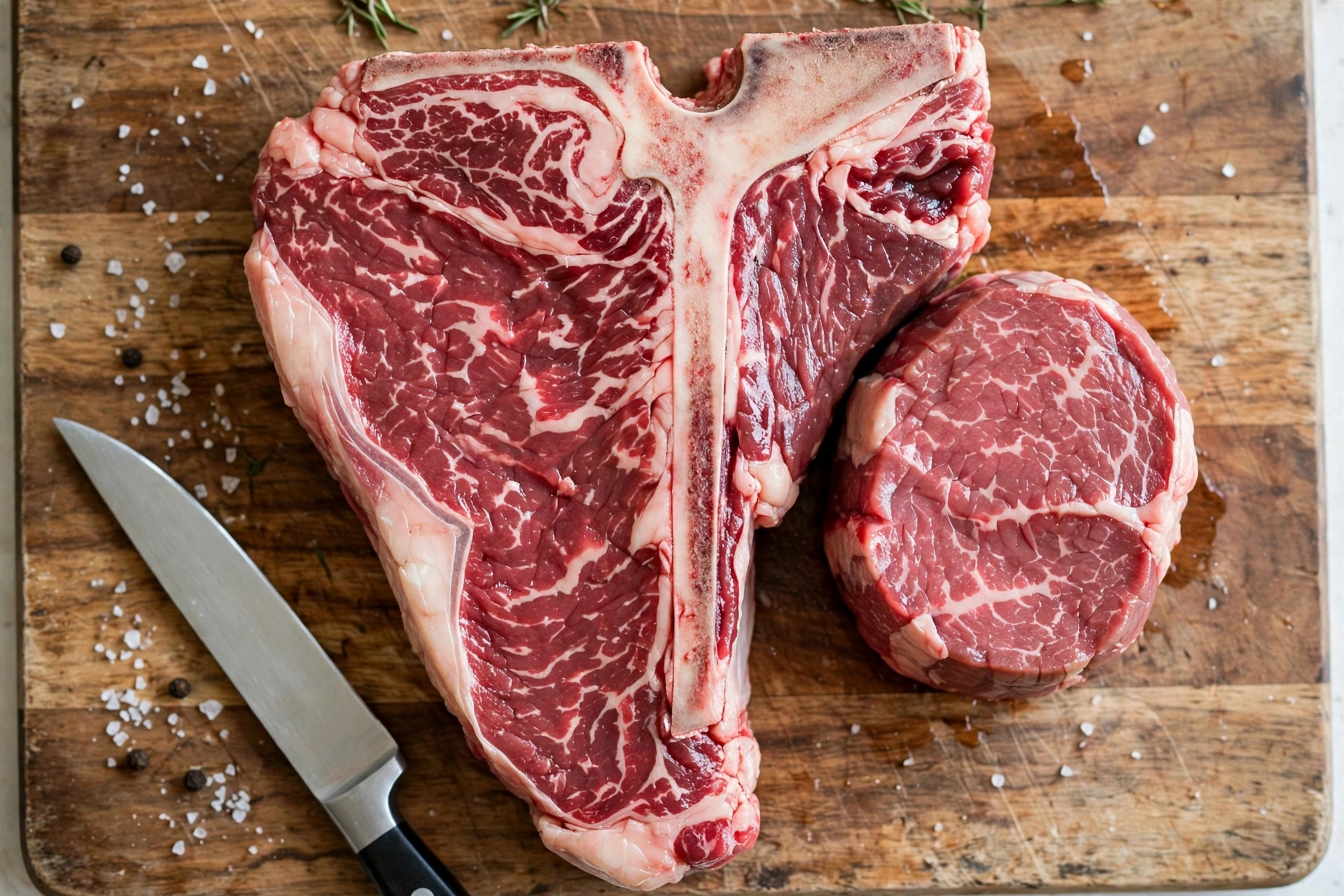
Porterhouse vs T-Bone at Texas Roadhouse: Quick Comparison
| Feature | Porterhouse (Texas Roadhouse) | Regular T-Bone (general) |
|---|---|---|
| Filet section width | At least 1.25 inches (USDA porterhouse standard) | Smaller than 1.25 inches |
| Weight at Texas Roadhouse | 23 oz | Not sold separately at Texas Roadhouse |
| What you get | Strip steak + filet, joined by the bone | Strip steak + smaller filet, joined by the bone |
| Best for | Sharing, or a very big appetite | One hungry diner |
| Price position | Most expensive steak on the menu | Usually cheaper than a porterhouse |
One practical note: because Texas Roadhouse only sells the porterhouse version, you cannot order a smaller T-bone there. If 23 oz sounds like too much steak, the honest alternatives are ordering the strip and the filet separately on different visits, or splitting the porterhouse with someone at the table.
How Big Is the Texas Roadhouse Porterhouse? Size, Calories and Nutrition
The numbers on this steak are consistent across sources in a way the price is not, which makes them the most reliable facts on the menu. The Porterhouse T-Bone weighs 23 oz, it is the largest steak Texas Roadhouse sells, and its calorie count is widely reported as 1,040 calories for the steak alone, before sides.
| Detail | Porterhouse T-Bone |
|---|---|
| Weight | 23 oz (1 lb 7 oz) |
| Calories | 1,040 cal (steak only, before sides) |
| Fat | Around 54 g total fat, around 24 g saturated fat (per the chain’s nutrition guide as reported by menu trackers) |
| Protein | High — a 23 oz steak is one of the highest-protein single plates on the menu |
| Grade | USDA Choice beef, like the rest of the steak menu |
| Sides included | Choice of two made-from-scratch sides |
| Serves | One very hungry diner, or two people sharing |
For scale, the next-biggest steaks on the menu are the 20 oz Bone-In Ribeye and the 16 oz cuts of ribeye, strip and sirloin. The porterhouse is three full ounces heavier than the bone-in ribeye, and nearly four times the weight of the 6 oz sirloin that is the chain’s best-selling steak. If you are counting calories, 1,040 is the steak alone. Add a loaded baked potato and a side of fries and the plate climbs quickly, so lighter sides like a house salad and green beans are the smarter pairing if the total matters to you.
Nutrition figures vary a little between fan-site trackers — one lists 750 calories and another lists 1,240 — but 1,040 calories is the figure repeated most often and the one that matches the chain’s own nutrition guide as quoted by multiple menu sites, so it is the figure to plan around.
How Much Does the Porterhouse Steak Cost at Texas Roadhouse?
Here is where honesty matters more than a single number. Fan-site price trackers that checked Texas Roadhouse menus in 2026 report the Porterhouse T-Bone at very different prices: $26.99, $28.99, $33.99, $34.99, $35.99 and $37.99 all appear for the same 23 oz steak. That is an $11 spread, and it is not a mistake in any one tracker — it reflects real differences between locations, different checking dates, and the price rises that rolled through 2026.
The most commonly reported figure in late 2026 is around $33.99 to $34.99, reported at some locations, and that is the range to budget for. But do not treat it as the price at your restaurant. Prices vary by location — confirm locally, in the Texas Roadhouse app or by calling the restaurant, before you plan a meal around a number. The one thing every source agrees on is the ranking: the porterhouse is the most expensive steak on the Texas Roadhouse menu, ahead of the 20 oz Bone-In Ribeye.
There is a useful way to think about that price. Split between two people, $34 to $38 buys two steak dinners — a filet portion and a strip portion, each with a share of two sides and unlimited rolls. Compared with ordering a Dallas Filet and a New York Strip separately, which together would cost considerably more, the porterhouse is genuinely good value per ounce. Eaten alone, it is a splurge. The value judgement depends entirely on whether you share it.
Is the Porterhouse Hand-Cut at Texas Roadhouse?
No — and this is the single most important thing to know before ordering it. Texas Roadhouse built its reputation on steaks hand-cut in the restaurant every day, and almost every steak on the menu is cut in-house by the restaurant’s own meat cutters. The Porterhouse T-Bone is the one exception. The restaurants do not have bone saws, so they cannot cut through the T-shaped bone in-house. The porterhouse arrives at the restaurant already cut, and Texas Roadhouse itself has confirmed to reporters that its porterhouse T-bone steaks are not prepared on premises.
Whether the steaks arrive frozen is a point of disagreement. A former employee posting on Reddit said the porterhouse is shipped in frozen and is “generally considered our not so good steak,” and several food sites repeat the frozen claim. The chain’s own training materials say the T-bones arrive fresh, never frozen. We cannot settle that conflict from public sources, so treat it as unresolved: the cut is definitely not hand-cut in-house, and the fresh-versus-frozen question is disputed.
Does it matter? For many diners, no. Reviewers who loved the steak loved it despite the pre-cutting, and Chowhound ranked it first out of all the chain’s steaks. But if the hand-cut story is the reason you choose Texas Roadhouse, the porterhouse is the one steak that does not deliver it. A Ft. Worth Ribeye or a Dallas Filet is cut in the restaurant that day, which is a real difference worth knowing.
What Does the Porterhouse Taste Like? The Reviews Disagree
The porterhouse T-bone inspires the most divided opinions of any steak at Texas Roadhouse, and the split is worth reporting honestly rather than smoothing over.
On one side, Chowhound’s steak ranking put the Porterhouse T-Bone at number one, praising its exterior crust, tender and juicy interior, and meaty flavour, and calling it well worth the price. The Daily Meal’s chain porterhouse ranking put Texas Roadhouse third, and diners quoted on Reddit called it “very juicy and flavorful from the marbling throughout the steak.” One food reviewer described the filet portion as so tender it was like dessert.
On the other side, Tasting Table lists the porterhouse among the steaks to avoid at Texas Roadhouse, citing the same uneven-cooking problem that affects any giant bone-in steak: the edges can overcook while the meat near the bone stays underdone. A Mashed writer who ordered it medium-well for carry-out found it dry and overcooked on arrival, though still tender enough to enjoy. In Tasting Table’s ranking of porterhouse steaks across 12 chains, Texas Roadhouse placed eighth — behind Outback, Peter Luger and Ruth’s Chris.
Both views describe the same steak. The porterhouse is a high-variance order: when the grill cook nails it, the bone keeps it juicy and the two textures make it the best plate in the building. When the cook misses, its sheer size punishes the mistake more than a smaller steak would. Your odds improve a lot if you order it medium-rare, eat it in the restaurant rather than as carry-out, and go at a busy time when the grill team is in rhythm.
Porterhouse vs Ribeye at Texas Roadhouse
The ribeye is the porterhouse’s main rival for the “best steak” title, and the comparison comes down to what you value. The Ft. Worth Ribeye is the most flavourful steak on the menu by the chain’s own description, thanks to marbling running through the whole cut. It is hand-cut in-house, it comes in 10, 12 and 16 oz sizes plus a 20 oz bone-in version, and it is easier to cook evenly than a 23 oz bone-in steak.
The porterhouse wins on variety and occasion. No ribeye gives you two different steaks on one plate, and no ribeye feeds two people. The ribeye wins on consistency, on flavour per bite, and on the hand-cut freshness story. Reddit’s regulars consistently name the ribeye the best steak to order at Texas Roadhouse, while professional rankings have gone both ways — Chowhound gave the top spot to the porterhouse, while other rankings put prime rib or the bone-in ribeye ahead of it.
If you want the safest great steak, order the ribeye. If you want the biggest, most shareable, most memorable steak, order the porterhouse. If you want tenderness above all, skip both and read the next section.
Porterhouse vs Filet and New York Strip
Since the porterhouse literally contains a filet and a strip, the fairest comparison is against ordering those two cuts on their own. The Dallas Filet is the most tender steak on the menu — the chain says so on the menu itself — and it is cut thick from the tenderloin, aged for extra tenderness, and available in 6 and 8 oz portions. The New York Strip is the chain’s second most tender steak, with a strip of fat along the top that keeps it juicy, available in 8 and 12 oz cuts.
Bought separately, a 6 oz filet and a 12 oz strip would cost more together than one porterhouse, and you would miss the bone’s contribution to flavour and juiciness. But you would also get two steaks cooked exactly to your liking, both hand-cut in-house, with no risk of one side overcooking while the other stays rare. The porterhouse trades that control for spectacle and value.
There is one more option worth knowing. Our guide to the filet medallions at Texas Roadhouse covers the three-piece filet plate that regulars and former employees often recommend instead of a full filet — it is a useful middle ground if the filet side of the porterhouse is the part you really want.
How to Order the Porterhouse Steak at Texas Roadhouse
Ordering this steak well is mostly about managing its size and its bone. These steps come from employee tips, reviewer experience, and the chain’s own menu guidance.
First, order it medium-rare. That is the doneness almost every reviewer and Reddit regular recommends for a cut this thick. The filet side cooks faster than the strip side, and medium-rare gives both sides room to finish well. Order it medium-well or above and the servers themselves will warn you that it may stay slightly pink around the bone while the edges dry out — the training manual says exactly that.
Second, decide before it arrives whether you are sharing. If two people are eating, ask for an extra plate and split the steak down the bone, one person taking the filet side and the other the strip. It is the fairest split in steakhouse dining, and it turns the most expensive steak on the menu into two reasonably priced dinners.
Third, eat it in the restaurant. The porterhouse loses more than smaller steaks do in a carry-out box, because a 23 oz bone-in steak keeps cooking in its own heat and steams inside the container. The Mashed carry-out review that found the steak dry is a warning worth heeding.
Fourth, pick sides that do not fight the steak. A loaded baked potato and a house salad is the classic pairing. Steak fries double down on richness. Green beans or steamed vegetables lighten a very heavy plate. And save room for the rolls — they are free, they are warm, and they are the right tool for the steak juices left on the plate.
Finally, consider the timing. Prime rib sells out on weekends because the roast is finite, but the porterhouse is a different kind of timing question: it is a big grill commitment, so ordering it when the kitchen is slammed on a Friday night is riskier than ordering it on a quieter weeknight.
Is the Porterhouse Steak Worth It?
Yes, for the right diner, and no, for the wrong one. It is worth it if you are sharing it with someone, if you genuinely want both a filet and a strip, if you are celebrating, or if you want the biggest steak Texas Roadhouse sells and you are ordering medium-rare in the restaurant. Split two ways, the reported price of around $34 to $35 is fair value for two steak dinners with two sides and rolls.
It is not worth it if you are eating alone and do not want leftovers, if you want your steak well done, if you are ordering carry-out, or if the hand-cut-in-house story matters to you — because this is the one steak that is not cut in the restaurant. In those cases, the hand-cut sirloin is the best value on the menu, the ribeye is the most flavourful, and the Dallas Filet is the most tender. Our full ranking of the best-selling steak at Texas Roadhouse lays out that choice in detail.
The honest summary is this: the porterhouse steak Texas Roadhouse serves is a genuine porterhouse, a real two-in-one steak, and the biggest plate on the menu — and also the highest-variance order on the menu, because its size makes it the hardest steak to cook evenly and the only one that is not hand-cut in-house. Order it medium-rare, share it, eat it there, and it can be the best steak in the building. Order it well done to go, and it can be the most disappointing. Now you know which version you are ordering.
Best Sides With the Porterhouse T-Bone
Every porterhouse comes with two sides, and the right pair makes the plate. A baked potato, loaded or plain, is the traditional partner and the one most diners choose. A house or Caesar salad cuts the richness and gives the plate something fresh. Green beans and steamed broccoli keep things lighter. Mac and cheese and fries lean into comfort and make the meal heavier — fine if you are sharing, a lot if you are eating the whole 23 oz alone. Buttered corn and seasoned rice are solid middle options. There is no wrong answer, but the best pairings balance the steak’s richness with something fresh or acidic on the side.
Frequently Asked Questions
Does Texas Roadhouse serve a porterhouse steak?
Yes. Texas Roadhouse serves a Porterhouse T-Bone, a 23 oz bone-in steak with a New York strip on one side of the bone and a filet on the other. It is the largest and most expensive steak on the menu, served with two sides.
How big is the porterhouse steak at Texas Roadhouse?
The Porterhouse T-Bone weighs 23 oz, which is 1 lb 7 oz before cooking. It is the biggest steak on the Texas Roadhouse menu, three ounces heavier than the 20 oz Bone-In Ribeye.
How much does the porterhouse steak cost at Texas Roadhouse?
Fan-site price trackers report a wide range for the same 23 oz steak in 2026, from $26.99 to $37.99, with around $33.99 to $34.99 the most commonly reported figure. Prices are reported at some locations and vary by location — confirm locally before ordering, as Texas Roadhouse does not publish one national price.
How many calories are in the Texas Roadhouse porterhouse steak?
The Porterhouse T-Bone is widely reported at 1,040 calories for the steak alone, before sides, with around 54 g of fat. A few trackers list different figures, from 750 to 1,240 calories, but 1,040 is the figure repeated most often and the one matching the chain’s nutrition guide as quoted by menu sites.
What is the difference between a porterhouse and a T-bone steak?
A porterhouse and a T-bone are the same cut from the short loin, with strip steak on one side and tenderloin on the other. The USDA defines a porterhouse as a T-bone whose filet section is at least 1.25 inches wide. A porterhouse is a T-bone with a bigger filet side, and Texas Roadhouse’s 23 oz cut meets that standard, which is why it is called the Porterhouse T-Bone.
Is the porterhouse at Texas Roadhouse the same as a T-bone?
Yes, in practice. Texas Roadhouse sells one bone-in short loin steak and calls it the Porterhouse T-Bone. It is a porterhouse by the USDA thickness standard and a T-bone by shape, so the two names describe the same plate.
Is the porterhouse hand-cut at Texas Roadhouse?
No. The Porterhouse T-Bone is the only steak on the menu that is not hand-cut in the restaurant, because the restaurants do not have bone saws to cut through the T-shaped bone. Texas Roadhouse has confirmed the porterhouse steaks are not prepared on premises. Whether they arrive frozen is disputed: a former employee on Reddit said they arrive frozen, while the chain’s training materials say they arrive fresh, never frozen.
Is the porterhouse steak at Texas Roadhouse worth it?
It is worth it if you share it, order it medium-rare, and eat it in the restaurant — split two ways, the reported price of around $34 to $35 is fair for two steak dinners. It is less worth it eaten alone, ordered well done, or as carry-out, when the giant bone-in cut is hardest to cook evenly. The ribeye, filet and sirloin are safer single-diner choices.
Can two people share the porterhouse at Texas Roadhouse?
Yes, and sharing is the most popular way to order it. At 23 oz it is built for two, with the filet side going to one person and the strip side to the other, and the two included sides can be split as well. Ask for an extra plate when you order.
What is the best way to order the porterhouse at Texas Roadhouse?
Order it medium-rare, eat it in the restaurant rather than as carry-out, and pair it with a baked potato and a salad or green beans. Medium-rare gives the fast-cooking filet side and the slower strip side the best chance of both finishing well, and the bone keeps the steak juicy as it rests.