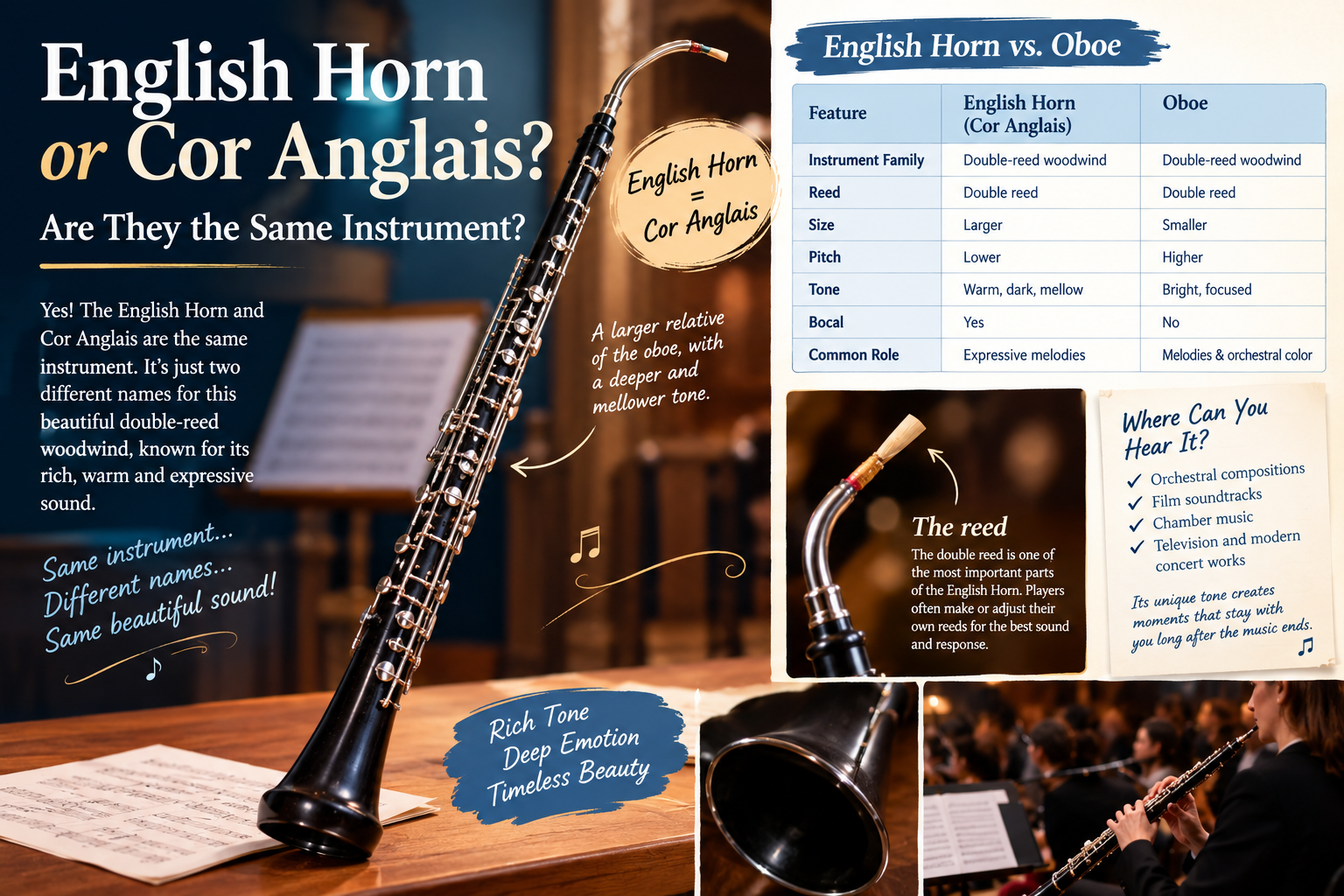
The English horn, also called the cor anglais, is a woodwind instrument with a warm, dark and slightly haunting sound. The two names make it seem like two different instruments, but English horn and cor anglais are the same instrument. “English horn” is the usual name in the United States while “cor anglais” is common in Britain and across Europe.
It belongs to the oboe family and is played with a double reed. You will hear it in orchestras, concert bands, chamber music and film scores, usually when a composer wants a quiet, expressive solo.
English Horn and Cor Anglais: The Same Instrument
The short answer is yes. English horn and cor anglais are two names for one instrument, so the difference is in the wording, not the design.
It is a larger cousin of the oboe. It uses a similar double reed, but its longer body gives it a lower, darker tone. It is pitched in F, a fifth below the oboe.
The name is also a bit misleading. The English horn is not a horn in the brass sense, and it is not particularly English either.
Why Does It Have Two Names?
“Cor anglais” is French and translates literally as “English horn.” Where the name came from is still debated. One theory says it began as a mix-up with the French word for “angled,” because early versions had a curved or bent shape. Another connects it to “angel” imagery. Music historians have not settled the question.
Either way, working musicians use both names for the same instrument.
How Does the English Horn Sound?
The English horn has a mellow, rounded and slightly nasal tone. Next to the brighter oboe, its voice sounds deeper and often more wistful.
A Voice Composers Love
Composers reach for the English horn when they want a solo that stands out from the rest of the orchestra. The sound can suggest loneliness, nostalgia, mystery or a calm landscape.
Two well-known examples are the famous Largo melody in Dvořák’s New World Symphony and Sibelius’s The Swan of Tuonela. In both, the English horn carries the emotional heart of the music.
English Horn vs. Oboe
The two instruments are close relatives, but the differences are easy to spot. The English horn is longer, larger and lower in pitch. It also has a bent metal tube called a bocal that holds the reed and connects it to the body.
| Feature | English Horn / Cor Anglais | Oboe |
| Instrument family | Double-reed woodwind | Double-reed woodwind |
| Reed | Double reed | Double reed |
| Size | Larger and longer | Smaller |
| Pitch | Lower | Higher |
| Key | F, a fifth below the oboe | C |
| Tone | Warm, dark, mellow | Bright, focused |
| Bocal | Yes | No |
| Bell shape | Rounded, pear-shaped | Flared, open |
| Typical player | Usually an oboist who doubles | A dedicated oboist |
| Common role | Expressive solos | Melodies and the orchestra’s tuning note |
In an orchestra the two often play together, and the contrast between bright and dark woodwind color is a big part of the appeal.
How Is the English Horn Played?
Playing it takes steady breath control, careful fingering and a well-made reed. As with other double-reed instruments, the player’s lips shape the reed while air passes through it.
The Role of the Reed
The reed matters more than almost anything else. Many players make or adjust their own, because even a tiny change can affect how easily the instrument speaks and how well it plays in tune.
That is why reed-making is such a valued skill among advanced players.
Its Place in the Orchestra
In most orchestras the English horn is played by an oboist who switches between oboe and English horn when the score calls for it. Often this is the third oboe player.
Because it sits lower than the oboe, it gives composers a darker color within the same woodwind family.
Where Can You Hear the Cor Anglais?
You can hear the cor anglais in many orchestral works, especially pieces with lyrical or atmospheric passages. It also appears in film soundtracks, television music, chamber ensembles and modern concert works.
Its tone works well when a composer wants something intimate or dramatic without using voices.
Why Is It Called a Horn?
The name confuses many people, because the English horn is not a brass instrument. It comes from old naming habits and has nothing to do with how the instrument is classified today.
It is a woodwind, since it makes sound with a double reed. The curved bocal and rounded bell give it a unique look, but the way it is built and played ties it closely to the oboe.
Final Thoughts
The English horn and the cor anglais are the same instrument, whatever the name on the page. It is a larger member of the oboe family with a lower, warmer and very expressive voice.
That sound has earned it a lasting place in orchestras and film music. Whether you read “English horn” in an American book or “cor anglais” in a European score, you are looking at the same double-reed instrument.
Knowing its name, its build and how it differs from the oboe makes it much easier to enjoy when you hear it in a performance.
Frequently Asked Questions About the English Horn
Are English horn and cor anglais the same instrument?
Yes. They are two names for the same double-reed woodwind.
Is the English horn part of the oboe family?
Yes. It is a larger relative of the oboe and uses a similar double reed.
Does the English horn sound like an oboe?
The sound is related, but the English horn is deeper, warmer and more mellow.
Why is it called an English horn?
The name comes from older European naming habits, and its exact origin is still debated.
Is the English horn a brass instrument?
No. It is a woodwind, because it produces sound with a double reed.