What Is a Fort Worth Ribeye?
A fort worth ribeye is Texas Roadhouse’s house name for its regular boneless ribeye steak — a hand-cut, heavily marbled cut from the rib primal of the cow, named after the city it celebrates. Fort Worth, Texas, is nicknamed Cowtown, and the chain gave its signature ribeye the city’s name to signal that this is a Texas-sized, Texas-style steak. It is not a separate cut of beef from a ribeye. It is a ribeye — the same muscle, the same marbling, the same flavour — sold under a name that tells you where the chain’s heart is.
Texas Roadhouse’s steaks are all hand-cut in the restaurant from whole primals, and the Fort Worth Ribeye is the chain’s signature ribeye. It is cut fresh each day by the meat cutters in the back of the house, and it is grilled over an open flame in the kitchen’s wood-fired grill. The ribeye is the most flavourful of the chain’s steaks because of its marbling — the streaks of fat running through the muscle that melt during cooking and keep the meat juicy. The Fort Worth Ribeye is the richest, most tender steak on the Texas Roadhouse menu, and it is the steak the chain’s regulars order when they want the full steakhouse experience.
The Fort Worth Ribeye is sold in three sizes — 12, 14, and 16 oz — and it is served with your choice of two made-from-scratch sides and fresh-baked rolls. It is the only ribeye on the menu that carries the Fort Worth name, and it is the only one that comes in three sizes. The regular ribeye, the bone-in ribeye, and the Dallas Filet all sit on the same menu page, but the Fort Worth Ribeye is the flagship.
This guide explains what the Fort Worth Ribeye is, how much it costs at real locations in 2026, what it contains nutritionally, how it compares to the bone-in ribeye and the Dallas Filet, and how to order it the way the regulars do. Every price and calorie figure here is reported from Texas Roadhouse’s own menu, its location listings, and independent nutrition guides — the chain does not publish a national price list, and prices vary by location, so confirm locally before you go.
Is the Fort Worth Ribeye Bone-In or Boneless?
The Fort Worth Ribeye is boneless. It is a boneless ribeye steak cut from the rib primal, and it is served without the bone. That is the whole point of the name: it is the chain’s premium boneless ribeye, and the Fort Worth name marks it out from the other ribeye on the menu — the 20 oz Bone-In Ribeye, which is the same cut with the bone left in.
The distinction matters, because the two steaks cook differently and serve different appetites. A boneless ribeye cooks faster and more evenly, and it is easier to cut and eat. A bone-in ribeye takes longer to cook, because the bone insulates the meat next to it, and it arrives at the table as a showpiece — a big, dramatic steak with the bone standing up. The Fort Worth Ribeye is the everyday premium choice. The bone-in ribeye is the occasion steak.
Some guides describe the Fort Worth Ribeye as a “bone-in ribeye,” and some listing pages list it alongside bone-in options, which is where the confusion comes from. The chain’s own menu is clear: the Fort Worth Ribeye is listed as a boneless ribeye, and the Bone-In Ribeye is a separate menu item with its own price and its own 20 oz size. If a guide tells you the Fort Worth Ribeye is bone-in, it has mixed the two items up.
There is one more source of confusion. Texas Roadhouse also sells a regular ribeye on some menus, and the Fort Worth Ribeye is sometimes listed simply as “ribeye” in the chain’s app and on third-party delivery pages. It is the same steak either way — the Fort Worth Ribeye is the chain’s ribeye, and the name is a house label, not a different cut.
Fort Worth Ribeye Sizes and Weights
The Fort Worth Ribeye comes in three sizes: 12 oz, 14 oz, and 16 oz. The 12 oz is the standard and the one most people order. The 14 oz is a modest step up for a bigger appetite, and the 16 oz is the full Texas-size portion — a serious steak that fills the plate.
The sizes are the cooked weight of the steak, and the chain’s menu lists them plainly: 12, 14, and 16 oz. The 12 oz is the best value of the three by price per ounce, because the price steps up by a fixed amount for each larger size while the steak itself is the same cut. The 14 oz costs about $3 more than the 12 oz, and the 16 oz costs about $5 more than the 12 oz — which means the 12 oz gives you the most steak for the least money per ounce, while the 16 oz gives you the most steak overall.
How big is a 16 oz ribeye, really? It is a pound of steak, and it is a lot of food. The 16 oz Fort Worth Ribeye is the largest steak Texas Roadhouse sells in its boneless range, and it is the steak to order if you are hungry and you want the full steakhouse experience. The 12 oz is already a generous portion — most chain restaurants’ ribeyes are 10 or 12 oz — and the 14 oz sits in between.
There is no 10 oz Fort Worth Ribeye. Older menus and some third-party guides list a 10 oz ribeye, but that is a different steak from an older menu or a different chain. The current Texas Roadhouse menu starts the Fort Worth Ribeye at 12 oz. If you want a smaller steak, the 6 oz sirloin on the Early Dine menu is the lighter option.
Fort Worth Ribeye Price (Reported, 2026)
Texas Roadhouse does not publish a national price for the Fort Worth Ribeye, so the honest answer is a range — and the range is wide, because the chain’s prices are set store by store. Here is what was actually reported at real locations and in menu guides in 2026.
| Item | Reported Price | Notes |
|---|---|---|
| 12 oz ribeye | $22.99 – $23.99 | 12 oz Fort Worth Ribeye |
| 14 oz ribeye | $25.99 – $26.99 | 12 oz Fort Worth Ribeye + $3 |
| 16 oz ribeye | $27.99 – $28.99 | 12 oz Fort Worth Ribeye + $5 |
| 20 oz bone-in ribeye | $31.99 – $32.99 | 16 oz Fort Worth Ribeye + $4 |
So what should you budget? A realistic figure for a 12 oz Fort Worth Ribeye in late 2026 is $22.99 to $23.99 at most locations, with the 16 oz running $27.99 to $28.99 and the 20 oz bone-in ribeye at $31.99 to $32.99. The prices in the table come from the chain’s own menu and from location listings, and they are consistent with the wider reporting: menu guides put the ribeye at $22.99 to $28.99 across the three sizes, and the bone-in at $31.99 to $32.99.
The price varies by state, and the pattern is the same one you see across the whole Texas Roadhouse menu. Texas locations, where the chain is based and where its supply chain is shortest, sit at the bottom of the range. California and Florida locations sit at the top. New York and the Northeast sit somewhere in the middle. The difference between the cheapest and the most expensive location for the same 12 oz steak is only about a dollar — the Fort Worth Ribeye is one of the more consistent prices on the menu.
One more thing to know: the Fort Worth Ribeye is not part of the Early Dine discount menu, and it is not on the Wednesday special. Early Dine’s sirloin is the smaller 6 oz sirloin, and the Wednesday special is the 8 oz sirloin. The Fort Worth Ribeye is a full-price steak, and it is worth it — but if you want the cheapest steak dinner at Texas Roadhouse, the Wednesday special or Early Dine will cost you less.
Fort Worth Ribeye Calories and Nutrition
The Fort Worth Ribeye is a rich steak, and its nutrition reflects that. The 12 oz Fort Worth Ribeye is reported at 960 calories, according to Texas Roadhouse’s own nutrition materials and the independent guides that reproduce them. That is for the steak alone, before sides, butter, or dressing.
| Item | Calories | Notes |
|---|---|---|
| 10 oz ribeye | ~800 cal | Smaller ribeye from older menus and other chains |
| 12 oz Fort Worth Ribeye | 960 cal (one guide: 880 cal) | The standard Fort Worth Ribeye |
| 14 oz Fort Worth Ribeye | 1,120 cal | Adding 2 oz adds about 160 calories |
| 16 oz Fort Worth Ribeye | 1,270 – 1,280 cal | The largest Fort Worth Ribeye |
| 20 oz bone-in ribeye | 1,480 cal | Estimated from the bone-in weight |
The calorie count rises in step with the size, at roughly 80 calories per ounce of steak. That is a useful rule of thumb: every extra 2 oz adds about 160 calories, so the jump from 12 oz to 16 oz is about 320 calories. The 16 oz Fort Worth Ribeye at 1,270 to 1,280 calories is a serious amount of food on its own — before you add a loaded baked potato, a side of mac and cheese, or a second roll.
One guide lists the 12 oz at 880 calories rather than 960, and the difference is probably a different cooking method or a different cut of the same steak. The chain’s own materials list the 12 oz at 960 calories, which is the figure to use. The 20 oz bone-in ribeye is listed at 1,480 calories in the same materials, which is consistent with the 80-calories-per-ounce rule once you allow for the weight of the bone.
The Fort Worth Ribeye is also high in fat, because the marbling that makes it tender is fat, and the chain’s nutrition materials list the ribeye among its highest-fat steaks. That is the trade-off with a ribeye: it is the most flavourful cut, and it is also the richest. If you want a leaner steak, the 6 oz sirloin is about 250 calories, and the Dallas Filet is leaner still. If you want the ribeye, order it and enjoy it — but pick lighter sides if you want to keep the meal reasonable.
The sides are where the meal’s total can double. A loaded baked potato, a serving of seasoned rice, or a Caesar salad with dressing can each add several hundred calories. Steamed broccoli, green beans, and a house salad with dressing on the side keep the meal lighter. The fresh-baked rolls are also worth counting: each roll with honey cinnamon butter is a few hundred calories on its own. Our guides to the Texas Roadhouse steak fries and the Texas Roadhouse seasoned rice cover the two most-searched sides in detail.

Ft Worth Ribeye vs Ribeye: Is There a Difference?
No, there is no difference. The Fort Worth Ribeye is a ribeye. The “Fort Worth” in the name is a house label that Texas Roadhouse gives its signature boneless ribeye, and it does not describe a different cut of beef. A ribeye is a ribeye — it is cut from the rib primal, it is heavily marbled, and it is the most flavourful steak on the menu. The Fort Worth Ribeye is all of those things, and the name is the chain’s way of celebrating Fort Worth, Texas, the city nicknamed Cowtown.
The confusion is understandable, because the chain’s menu lists both a “Fort Worth Ribeye” and a “Bone-In Ribeye,” and some guides treat them as two different cuts. They are two different presentations of the same cut: one boneless, one bone-in. The Fort Worth Ribeye is the boneless presentation, and the Bone-In Ribeye is the bone-in presentation. They come from the same primal, and they have the same flavour profile.
There is also a “regular ribeye” on some Texas Roadhouse menus, and it is the same steak again. The chain’s app and third-party delivery pages sometimes list the steak simply as “ribeye,” and that is the Fort Worth Ribeye under a shorter name. If you order a ribeye at Texas Roadhouse, you are ordering the Fort Worth Ribeye, whatever the listing calls it.
The name is a branding choice, not a butchery choice. Texas Roadhouse is a Texas chain, and Fort Worth is the Texas city most associated with cattle. The chain named its flagship ribeye after the city to tell you that this is a Texas steak — big, bold, and unapologetically rich. The Dallas Filet gets the same treatment: it is a filet mignon named after Dallas. The names are the chain’s way of putting Texas on the menu.
Ft Worth Ribeye vs Bone-In Ribeye: Which Should You Order?
The Fort Worth Ribeye and the Bone-In Ribeye are the same cut in two forms, so the choice comes down to size, price, and how you like to eat a steak. Here is the breakdown.
| Fort Worth Ribeye | Bone-In Ribeye | |
|---|---|---|
| Cut | Boneless ribeye | Bone-in ribeye |
| Size | 12, 14, 16 oz | 20 oz |
| Calories | 960 – 1,280 cal | 1,480 cal |
| Price | $22.99 – $28.99 | $31.99 – $32.99 |
| Marbling | Heavy | Heavy |
| Cook time | Faster | Slower |
| Serving | Steakhouse classic | Showpiece |
Order the Fort Worth Ribeye if you want the classic steakhouse ribeye in a size you can choose. The 12 oz is the standard, the 16 oz is the big appetite portion, and the boneless cut is easier to eat and cooks more evenly. It is the steak to order on a normal visit, and it is the one the regulars order most.
Order the Bone-In Ribeye if you want the showpiece. It is a 20 oz steak, it arrives with the bone standing up, and it is the most dramatic plate on the menu. It costs about $4 more than the 16 oz Fort Worth Ribeye, and you get 4 oz more steak for it — so it is not a bad value by the ounce. But it is a lot of food, and the bone means some of that 20 oz is not meat. If you are very hungry and you want the biggest steak in the restaurant, the bone-in is the one.
There is a small flavour difference, and it is real. The bone insulates the meat next to it, so the bone-in ribeye cooks a little more slowly and a little more gently around the bone, and some steak lovers say the meat near the bone is the most flavourful part of the cut. The difference is subtle, and most people will not notice it. The bigger difference is the experience: the bone-in is a statement, and the Fort Worth Ribeye is the everyday premium.
Fort Worth Ribeye vs Dallas Filet
The Fort Worth Ribeye and the Dallas Filet are the two premium steaks on the Texas Roadhouse menu, and they are opposites in almost every way. The ribeye is rich, marbled, and bold. The filet is lean, tender, and delicate. Choosing between them is a matter of taste, not quality.
The ribeye’s marbling is its flavour. The fat melts during cooking and bastes the meat from the inside, which is why a ribeye tastes beefier and juicier than a filet. The filet’s tenderness is its virtue: it is the most tender cut on the menu, cut from the tenderloin, and it has almost no fat. It is the steak to order if you want the softest bite, and the ribeye is the steak to order if you want the biggest flavour.
The Dallas Filet is also the more expensive steak per ounce, and it is sold in smaller sizes — 6 oz and 8 oz are the standard, with a 10 oz option at some locations. The Fort Worth Ribeye is sold in 12, 14, and 16 oz, so it gives you more steak for the money. If you are hungry, the ribeye is the better value. If you want the most tender steak in the restaurant and you do not need a pound of beef, the filet is the better choice. Our guide to the Texas Roadhouse Dallas Filet covers the filet in the same detail as this guide covers the ribeye.
How Texas Roadhouse Cooks the Fort Worth Ribeye
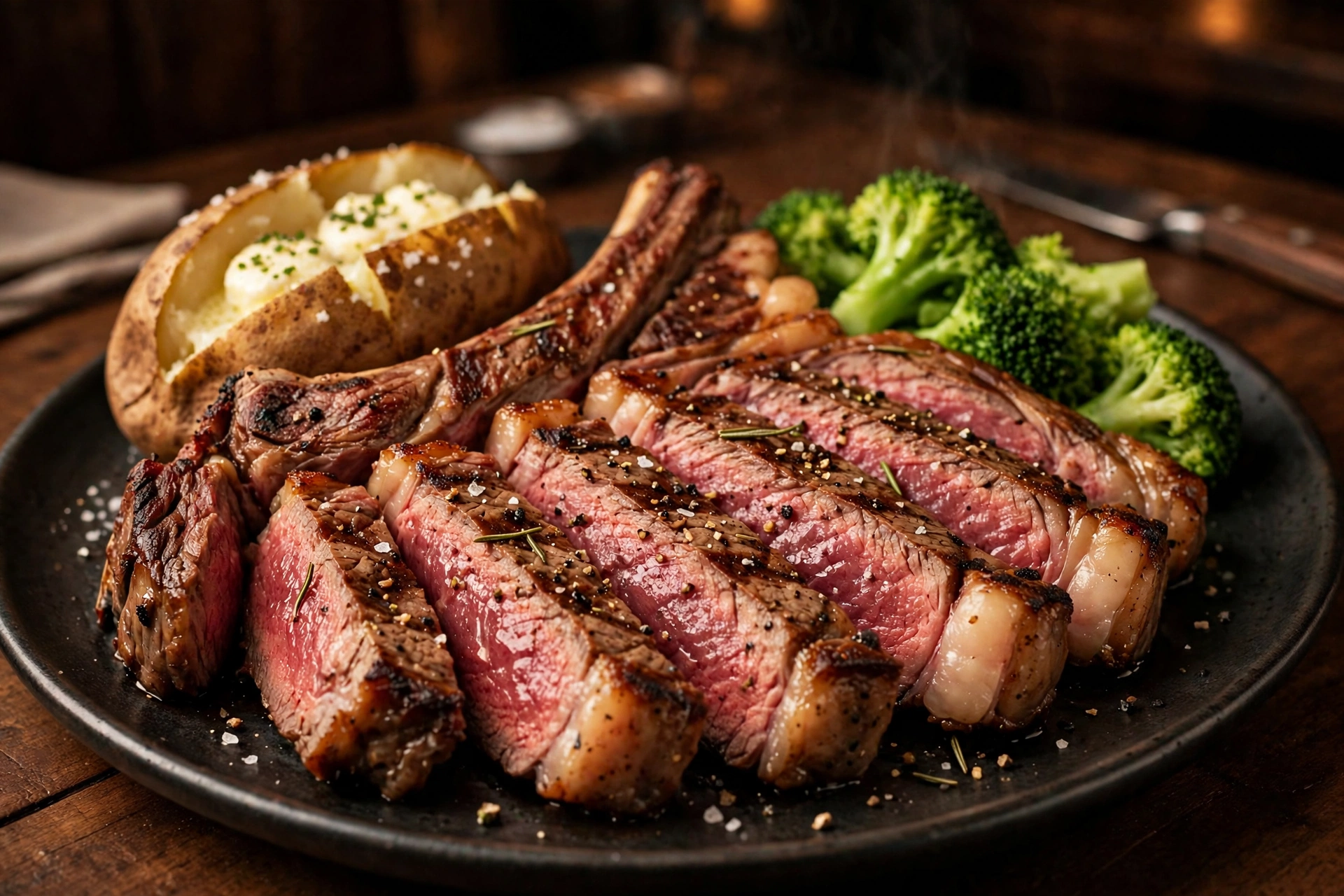
Texas Roadhouse grills its steaks over an open flame, and the Fort Worth Ribeye is cooked the same way. The steaks are hand-cut in the restaurant each day, seasoned with the chain’s steak seasoning, and grilled to order. You order it cooked the way you like it — rare, medium-rare, medium, medium-well, or well done — and the kitchen grills it over high heat to get a seared crust on the outside and a juicy interior.
Medium-rare is the doneness the chain’s own guides recommend for the ribeye, and it is the doneness most regulars order. A ribeye cooked medium-rare is warm and pink in the centre, with the marbling melted and the fat rendered, and it is the temperature that shows off the cut’s flavour best. Medium is the safer choice if you do not like pink meat, and it is still juicy. Well done is the least forgiving — a ribeye cooked well done loses much of its juiciness, and the chain’s guides warn that the fat can dry out if the steak is overcooked.
The ribeye is a thick steak, especially in the 16 oz size, and thick steaks need a little more time on the grill. The kitchen will let a thick ribeye rest for a minute before it comes to the table, which lets the juices settle. If your steak arrives and you want it cooked a little more, the server will take it back and finish it — Texas Roadhouse is used to that request, and it is better to send it back than to eat a steak cooked past the point you wanted.
Best Sides for the Fort Worth Ribeye
The Fort Worth Ribeye comes with two sides, and the side choice is where you can make the plate feel like a much more expensive dinner — or keep it manageable. The most popular pairings with the ribeye are the ones regulars order with any steak: a loaded baked potato and steak fries for the full comfort-food plate, or mashed potatoes and green beans for the classic steakhouse combination.
If you want the best value from the two-sides rule, pick the sides that cost the most on their own. The baked potato and the house salad are the priciest à la carte sides at most locations, so pairing those two with the ribeye stretches the meal furthest. The loaded baked potato — butter, sour cream, cheese, bacon bits, and chives — is the single most-ordered side at the chain, and it pairs naturally with a grilled ribeye.
If you want the lightest version of the plate, the steamed broccoli and the house salad are the obvious picks. The ribeye itself is a rich steak, so a light side keeps the meal from becoming overwhelming. The grilled ribeye with steamed broccoli and a house salad is the lightest way to eat the chain’s flagship steak, and it is still a full dinner.
One more tip: the sides are made from scratch daily, and the kitchen will swap in any side on the list. There is no restriction on which sides go with the ribeye — if you want seasoned rice and Texas Red Chili with your steak, you can have them. Our guides to the Texas Roadhouse steak fries and the Texas Roadhouse seasoned rice cover the two most-searched sides in detail.
Is the Fort Worth Ribeye Worth It?
Yes, if you want a ribeye. The Fort Worth Ribeye is the best ribeye on the Texas Roadhouse menu, and it is one of the best ribeyes you will find at a chain steakhouse at this price. A 12 oz hand-cut ribeye with two made-from-scratch sides and fresh-baked rolls for $22.99 to $23.99 is a fair price for a steak of this quality, and the 16 oz at $27.99 to $28.99 is a lot of steak for the money.
The value is better than the price suggests, because the steak is hand-cut in the restaurant from whole primals, and the sides are made from scratch. You are not getting a frozen, pre-portioned steak — you are getting a steak that was cut in the back of the house that day, grilled over an open flame, and served with sides that were made that morning. That is the difference between Texas Roadhouse and a fast-food steak, and it is why the Fort Worth Ribeye has the reputation it does.
The honest caveats: the ribeye is a rich steak, and it is not the cheapest steak on the menu. The 8 oz sirloin is about $16.99, and the Wednesday special puts it at $14.49 to $18.99 at most locations. The Fort Worth Ribeye costs about $6 more than the sirloin dinner, and it is worth it if you want the ribeye’s flavour — but if you want the cheapest steak dinner, the sirloin is the better value. And if you want the most tender steak, the Dallas Filet is the better choice, though it costs more per ounce.
The bottom line is simple: if you are at Texas Roadhouse and you want a ribeye, order the Fort Worth Ribeye. Order the 12 oz if you want the best value, the 16 oz if you are hungry, and the bone-in if you want the showpiece. Order it medium-rare, pick two sides you love, and enjoy the best steak the chain makes.
How to Order the Fort Worth Ribeye Like a Regular
Ordering the Fort Worth Ribeye is straightforward, but a few habits will get you a better steak. First, order it medium-rare unless you have a strong preference otherwise. The ribeye’s marbling needs heat to render, and medium-rare is the temperature that does it best. If you order it rare, the fat will not fully render, and the steak will be chewier than it should be. If you order it well done, the fat will dry out and the steak will be tougher.
Second, ask for the size you want by name. The menu lists 12, 14, and 16 oz, and the server will ask which size you want. The 12 oz is the standard, and it is the one to order if you are not sure. The 16 oz is the one to order if you are hungry, and the 14 oz is the middle ground. There is no wrong choice, but the 12 oz is the best value per ounce.
Third, pick your sides before you sit down, or at least have two in mind. The server will ask for your two sides when you order, and the most popular pairings are a loaded baked potato and steak fries, or mashed potatoes and green beans. If you want the lightest plate, steamed broccoli and a house salad are the picks. The rolls come with the meal, so you do not need to order them.
Fourth, if you want to save money, consider the timing. The Fort Worth Ribeye is not on the Wednesday special or the Early Dine menu, but the Wednesday special is the cheapest steak dinner of the week, and our guide to the Texas Roadhouse Wednesday special covers it in detail. If you want the ribeye and you want to save, the Early Dine sirloin is the cheaper steak — but it is a sirloin, not a ribeye, and it is a smaller cut.
Fifth, if you are ordering for a group, the family meal packs are worth a look. They bundle a main, sides, and rolls for four or more, and they are available every day. Our guide to Texas Roadhouse family meals breaks them down. And if you are visiting in the late afternoon, check the Texas Roadhouse early bird menu first — it runs Monday through Thursday and it is the cheapest dinner in the restaurant.
Frequently Asked Questions About the Fort Worth Ribeye
What is a fort worth ribeye?
A fort worth ribeye is Texas Roadhouse’s boneless hand-cut ribeye steak — a thick, heavily marbled cut from the rib primal of the cow, named after Fort Worth, Texas, the city nicknamed Cowtown. It is a regular ribeye given a Texas house name, not a different cut of beef.
Is the Fort Worth Ribeye bone-in or boneless?
The Fort Worth Ribeye is boneless. The bone-in option on the Texas Roadhouse menu is the separate 20 oz Bone-In Ribeye, which is the same cut with the bone left in.
How much is a Fort Worth Ribeye at Texas Roadhouse?
Reported prices in 2026 are $22.99 to $23.99 for the 12 oz, $25.99 to $26.99 for the 14 oz, and $27.99 to $28.99 for the 16 oz. The 20 oz bone-in ribeye is $31.99 to $32.99. Prices vary by location — confirm locally.
How many calories are in a Fort Worth Ribeye?
The 12 oz Fort Worth Ribeye is reported at 960 calories for the steak alone, before sides. The 14 oz is about 1,120 calories, and the 16 oz is 1,270 to 1,280 calories. One guide lists the 12 oz at 880 calories.
What is the difference between a Fort Worth Ribeye and a regular ribeye?
There is no difference in the cut. The Fort Worth Ribeye is Texas Roadhouse’s house name for its boneless ribeye, named after Fort Worth, Texas. A regular ribeye and a Fort Worth Ribeye are the same steak.
Is the Fort Worth Ribeye the same as the bone-in ribeye?
No. The Fort Worth Ribeye is boneless and comes in 12, 14, and 16 oz. The bone-in ribeye is a separate 20 oz steak with the bone left in, priced at $31.99 to $32.99. They come from the same rib primal but are served differently.
What sizes does the Fort Worth Ribeye come in?
The Fort Worth Ribeye comes in three sizes: 12 oz, 14 oz, and 16 oz. The 12 oz is the standard and the best value per ounce, the 14 oz is a step up, and the 16 oz is the full Texas-size portion.
Is the Fort Worth Ribeye worth it?
Yes, if you want a ribeye. A hand-cut 12 oz ribeye with two made-from-scratch sides and fresh-baked rolls for $22.99 to $23.99 is a fair price for a steak of this quality, and it is one of the best ribeyes at a chain steakhouse at this price.
What sides go best with the Fort Worth Ribeye?
The most popular pairings are a loaded baked potato and steak fries, or mashed potatoes and green beans. For the lightest plate, steamed broccoli and a house salad are the best picks. Any two sides from the full Texas Roadhouse sides list are included.
Is the Fort Worth Ribeye better than the Dallas Filet?
It depends on what you want. The ribeye is richer and more flavourful because of its marbling, and it gives you more steak for the money. The Dallas Filet is leaner and more tender, and it is sold in smaller 6 oz and 8 oz sizes. If you want flavour and value, order the ribeye. If you want the most tender steak, order the filet.