
A research dossier for a target company is a single, well-sourced document that pulls together everything you can verify about one company — its legal identity, ownership, leadership, products, finances, competitors, legal record, and risks — so you can make one specific decision about it. Sales reps build dossiers before big calls. Buyers build them before acquisitions. Investors build them before writing checks. This guide covers exactly what goes into a dossier, where to find each piece of information for free, a nine-step process for building one, and a copy-and-fill template you can use today.
What Is a Research Dossier for a Target Company?
A research dossier is a dated report about one company, built to support one decision: Should we sell to them? Buy them? Invest in them? Partner with them? Hire them as a vendor?
One clarification first: “target company” simply means the company you are researching. It has nothing to do with Target Corporation, the retailer — the same structure works for a ten-person supplier or a public company.
What separates a dossier from a folder of screenshots and search results is discipline. Every important fact carries a source and a date. Every claim is labeled as confirmed, a company claim, an estimate, or unverified. And the uncomfortable findings — lawsuits, gaps, contradictions — stay in, because they are usually the part that changes the decision.
When Do You Need a Research Dossier?
The structure stays the same across use cases; only the depth and emphasis change. Match the effort to the size of the decision:
| Use case | Depth | Focus on |
|---|---|---|
| Sales prospecting | Light | Identity, products, decision-makers, hiring and trigger events (new leaders, funding, expansion) from the last 90 days |
| Competitor analysis | Medium | Products, pricing approach, market position, digital footprint |
| Vendor or partner check | Medium to deep | Legal identity, ownership, legal/regulatory record, reputation, financial stability |
| Investment screening | Deep | Financials, funding history, leadership, market, risks |
| Acquisition (M&A) screening | Deep — then professional review | Financial, legal, customer, operational and tax findings; the dossier is the screening layer before formal due diligence |
| Job interview prep | Light to medium | Products, leadership, financial health, reputation |
The rule of thumb: a first-pass dossier for a sales call is a short working document. A dossier behind a purchase or investment decision is a serious research project — and even then, it is a screening tool, not a substitute for professional due diligence by lawyers and accountants.
Research Dossier vs. Company Profile vs. Due Diligence
Three documents get confused with each other constantly. Here is the difference:
| Document | Purpose | Depth | Typical users |
|---|---|---|---|
| Research dossier | Support a specific decision | Medium to deep | Sales teams, analysts, founders, recruiters |
| Company profile | Describe a business | Usually light | Marketing and media teams |
| Due diligence | Examine a specific transaction | Deep and deal-specific | Lawyers, accountants, investors, buyers |
| Sales battlecard | Win competitive deals | Narrow and focused | Sales reps |
A company profile tells you what a business says about itself. A dossier checks those claims against independent records and says what could not be verified. Due diligence goes further still: it works from private documents — contracts, tax returns, bank records — that a target company hands over during a transaction, which no amount of public research can replace.
What Goes Into It: The 12 Sections
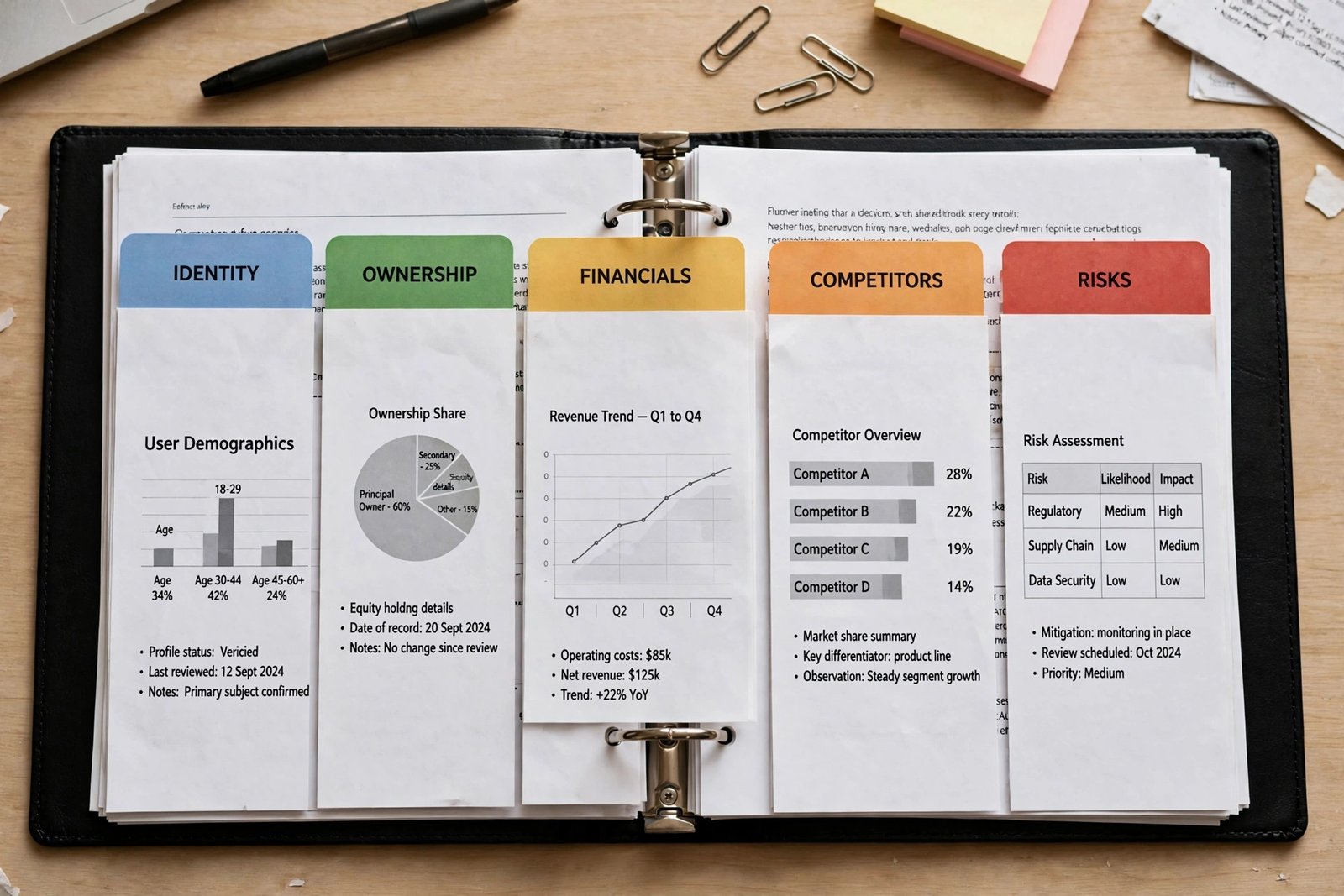
A complete research dossier for a target company covers twelve areas. Not every dossier needs all twelve at full depth — a sales-call version might use six — but skipping a section should be a choice, not an accident.
| # | Section | What to capture | Where to check (US) |
|---|---|---|---|
| 1 | Identity and legal entity | Legal name, trade names, state of formation, registered agent, entity status | Secretary of State business search |
| 2 | Ownership and structure | Parent companies, subsidiaries, disclosed investors | SEC filings, state records, company disclosures |
| 3 | Leadership and board | Names, roles, relevant background, recent changes | Proxy statements, official leadership pages, filings |
| 4 | Products and customers | What they sell, and to whom | Company website, annual reports |
| 5 | Business model and pricing | Revenue streams, pricing approach, recurring revenue | Pricing pages, filings, customer documentation |
| 6 | Financial information | Revenue, profit, debt, funding — always with the reporting period | SEC EDGAR, Form D filings, company reports |
| 7 | Market and competitors | Direct competitors, substitutes, market position | Annual reports, industry research |
| 8 | Hiring and growth signals | Open roles, stated expansion plans, workforce trends | Careers pages, job boards, company reports |
| 9 | Legal and regulatory matters | Lawsuits, liens, enforcement actions, compliance issues | PACER, state courts, UCC records, OSHA, EPA ECHO |
| 10 | Reputation | Reviews, complaints, news coverage, company responses | CFPB, FTC, BBB, reputable news |
| 11 | Digital footprint | Official domain, official pages, online presence | Official website, domain records, search tools |
| 12 | Risks and recommendation | Strengths, weaknesses, unknowns, next steps | Your evidence log and analysis |
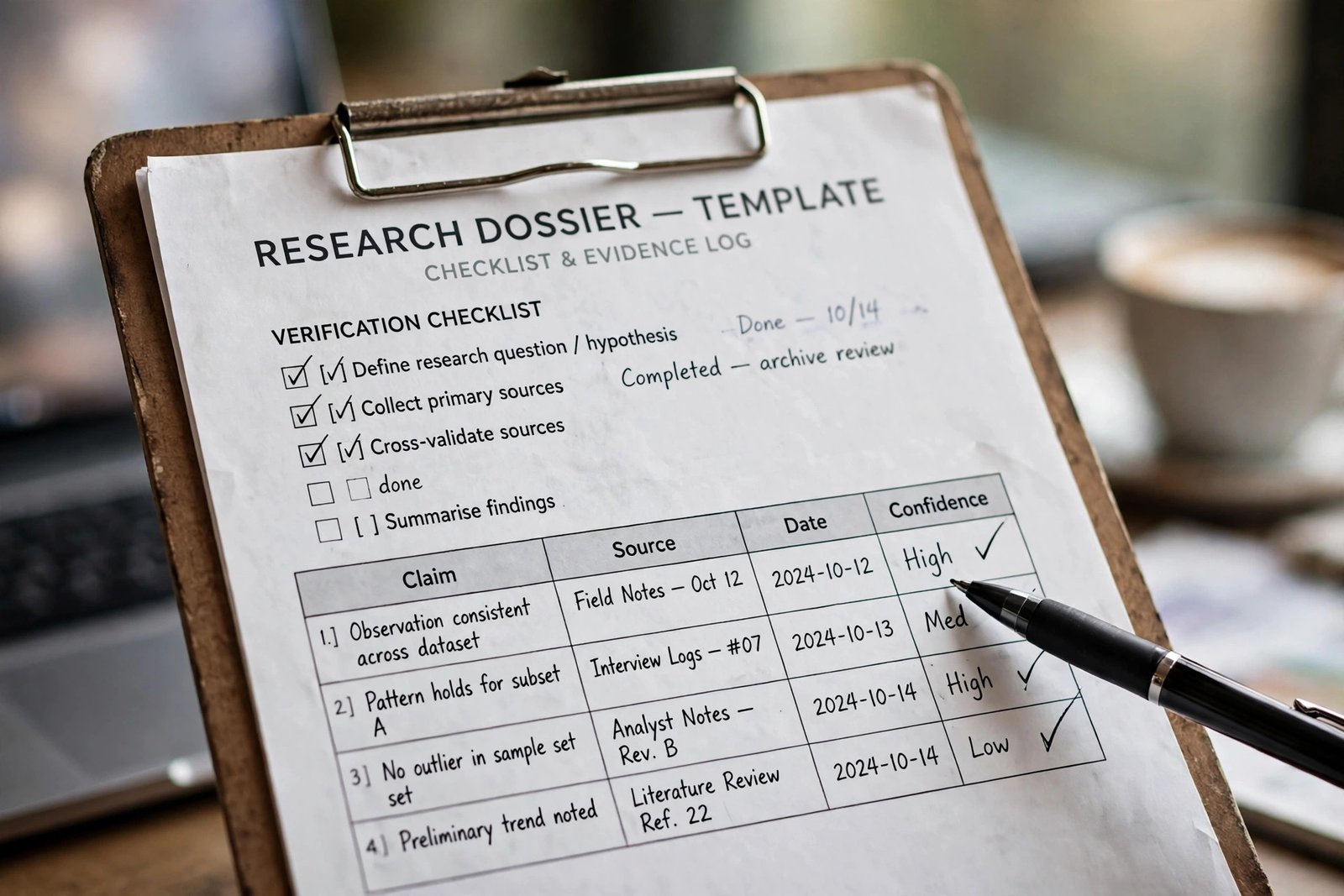
Behind the twelve sections sits one working tool: an evidence log. For every important claim, record the claim itself, the source, the source’s date or reporting period, the date you accessed it, and a confidence label. When a section has nothing in it, write “not found in the sources checked” and the date — a recorded gap is information; a silent gap is a trap for whoever reads the dossier next.
How to Build a Research Dossier for a Target Company: Step by Step
- State your decision in one sentence. “I need to decide whether this company is a reliable supplier for us.” That sentence decides which data is relevant and which is noise. Dossiers built without it turn into fact dumps.
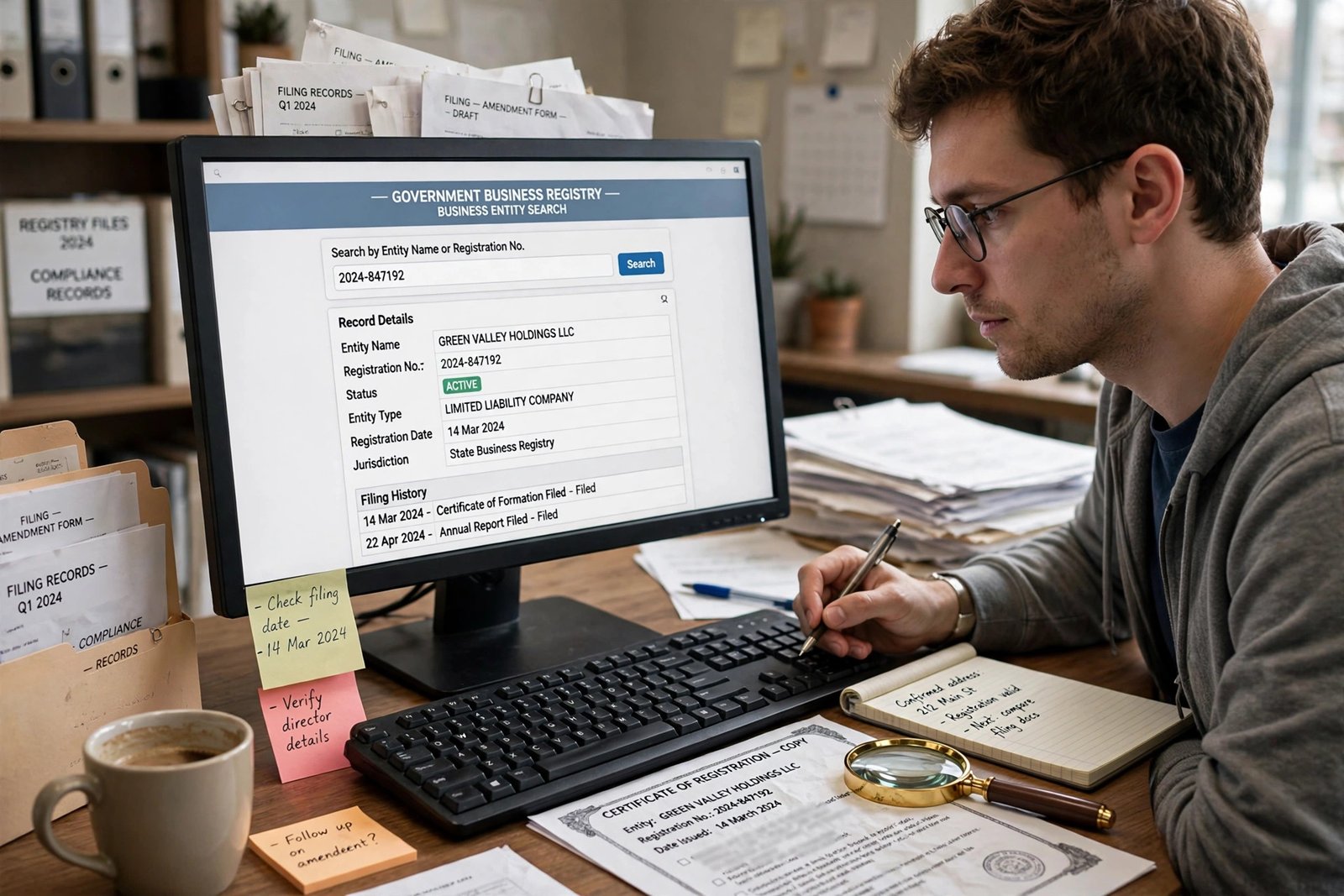
- Identify the exact company. Brand names differ from legal names, and unrelated companies share similar names. Pin down the legal name, the state it is registered in, and any parent company before you collect anything — researching the wrong entity is the most common dossier failure.
- Confirm the official website. Match the legal name in the site’s footer against the registry record. Check that the About, Privacy, and Terms pages use consistent names and contact details, and that official social profiles link back to the same domain. Look-alike domains are common; a polished design is not proof of anything.
- Collect from primary sources first. State registries, SEC filings, trademark records, and court records outrank every summary site. For each source, note the URL, the document title, its publication date, and the date you accessed it, so anyone can repeat your search.
- Add secondary sources as leads, not proof. News articles, reviews, funding databases, and analyst write-ups point you toward things worth verifying. A claim that only exists in a secondary source stays labeled as such.
- Verify and label every claim. Check names, dates, numbers, and reporting periods against the original document. Then label each finding: Confirmed (primary source), Company claim (the company says it), Estimate (a third party’s approximation), or Unverified.
- Analyze, don’t just accumulate. Run a short SWOT: strengths, weaknesses, opportunities, threats. Separate the facts from your opinion of the facts, and name the risks that bear on your decision — heavy dependence on a few customers, key-person risk, a pattern of complaints.
- Write the executive summary last, place it first. Lead with your recommendation, the three most important findings, and the three biggest unknowns. A reader who stops after page one should still understand your conclusion and its limits.
- Set a review date. Companies change. Refresh the dossier before any new major decision involving the company, and whenever leadership, legal, or financial news breaks.
Where to Find Company Information: The Best Sources
Most of a good dossier can be built from free, primary sources. Start here before paying for any database:
- SEC EDGAR — filings for US public companies: annual reports (10-K), quarterly reports (10-Q), event filings (8-K), proxy statements, and Form D notices when private companies raise capital.
- Secretary of State business searches — every US state publishes a registry showing whether a legal entity exists, its status, its formation date, and its registered agent. This is step one for identity.
- USPTO trademark search — the brands and product names a company actually owns or has applied for.
- PACER and state court records — federal lawsuits and bankruptcies. PACER charges a small per-page fee under its published rules; many state court searches are free.
- CFPB complaint database, the FTC, and the BBB — consumer complaints and enforcement actions, for the reputation section.
- OSHA and EPA ECHO — workplace-safety and environmental records, where the industry makes them relevant.
- OpenCorporates — a cross-border index of company registry records, useful when a target has entities in several countries. Outside the US, official registries such as the UK’s Companies House play the same role as a state registry.
- The company’s own website and careers page — products, pricing approach, leadership pages, and hiring signals. Treat everything here as a company claim until an independent source backs it.
Paid platforms — company databases such as Crunchbase and PitchBook for funding and ownership data, contact databases such as ZoomInfo and Apollo, and LinkedIn for people and headcount signals — can speed up collection and fill gaps on private companies. Use them as accelerators, not authorities: their figures are frequently estimates, they can be stale, and coverage and pricing vary by provider and plan. Anything decision-critical still gets checked against a primary record.
Tools That Help
| Tool category | What it does in a dossier |
|---|---|
| Search engines | Finding public information and locating primary records |
| Government registries & filings | The primary-source backbone: identity, financials, legal record |
| Business data platforms | Funding, ownership, market and contact research (often estimates) |
| Spreadsheets | The evidence log: claim, source, date, label, confidence grade |
| Document tools | Assembling the final report and template |
| AI assistants | Organizing notes, suggesting sources, summarizing verified material — never verifying facts for you |
Free Template: A Copy-and-Fill Research Dossier Outline
Copy this structure into a document or spreadsheet and fill it in. It follows the same twelve sections, with the research discipline built in.
Cover block
- Company (legal name): ____________
- Official website (domain): ____________
- Research objective / decision to support: ____________
- Geographic scope: ____________ · Research period: ____________ · Cutoff date: ____________
- Researcher: ____________ · Next review date: ____________
Executive summary (write last, place first)
- Bottom-line recommendation: ____________
- Three most important findings: ____________
- Three biggest unknowns: ____________
Sections 1–11 — one block each: Identity and legal entity · Ownership and structure · Leadership and board · Products and customers · Business model and pricing · Financial information (with reporting period) · Market and competitors · Hiring and growth signals · Legal and regulatory matters · Reputation · Digital footprint. Under each block, record findings as short bullets, each ending with its source and label.
Section 12 — Risks, opportunities, and recommendation
- Strengths / Weaknesses / Opportunities / Threats: ____________
- What could materially change this conclusion: ____________
- What needs professional due diligence (legal, financial, tax, technical): ____________
Evidence log — one row per important claim: Claim | Source | Source date / period | Date accessed | Label (Confirmed / Company claim / Estimate / Unverified) | Confidence grade (A: primary source, B: reputable secondary, C: weak or self-reported).
Information gaps — list everything you could not verify: unknown financials, unknown ownership detail, unknown customer information. Write “not found in the sources checked” rather than leaving blanks.
Using AI to Help — Without Letting It Invent Facts
AI assistants are genuinely useful in dossier work: they organize scattered notes, suggest where a record might live, compare competitors, and summarize long filings. They also confuse similarly named companies, misread documents, and produce citations that do not support the claim attached to them.
The safe workflow is Search → Collect → Verify → Analyze → Write. Let AI help with the collecting and organizing. Do the verifying yourself: open every cited link, check the date and reporting period, match the company name against the registry, and compare figures with the original document. A controlled request works far better than a broad one — instead of “tell me everything about Company X,” ask the tool to work only from sources you provide, separate confirmed facts from interpretations, flag contradictions, and list what it could not find. Anything the AI cannot tie to a source you have opened gets labeled Unverified or deleted.
Common Mistakes That Ruin a Dossier
- Researching the wrong company. Similar names, trade names, and subsidiaries are everywhere. Confirm the legal entity before you combine information from multiple sources.
- Mixing reporting periods. Comparing one company’s 2023 revenue with a rival’s 2025 figure, without saying so, manufactures a conclusion. Keep periods aligned and labeled.
- Treating estimates as facts. Private-company revenue and headcount numbers online are usually third-party estimates. Label them, or they will quietly harden into “facts” as the dossier gets reused.
- Assuming “no results” means “no problem.” A search that finds no lawsuits proves only that the search found none — coverage varies by state and record type. Record the search and its date instead of declaring a clean record.
- Trusting AI output without opening the sources. Confident, well-formatted, and wrong is a real failure mode. Verify before anything reaches the summary.
- Writing a long report with no decision in it. Facts without a recommendation, risks, and open questions are homework, not a dossier. End with what you conclude and what would change your mind.
- Never updating it. Leadership changes, lawsuits land, funding rounds close. A stale dossier presented as current is worse than an honestly dated one.
Frequently Asked Questions
What is a research dossier for a target company?
A dated report that collects sourced information about one company to support one decision. It typically covers legal identity, ownership, leadership, products, business model, finances, competitors, hiring signals, legal and regulatory matters, reputation, digital footprint, and risks — with an evidence log behind the important claims.
What should a company research dossier contain?
The twelve areas listed in this guide: identity, ownership, leadership, products and customers, business model and pricing, financial information, market and competitors, hiring signals, legal and regulatory matters, reputation, digital footprint, and a closing risks-and-recommendation section — plus an executive summary up front and an evidence log underneath.
How do I research a private company in the US?
Start with the Secretary of State registry in the company’s state and its official website. Then check any SEC filings that exist (Form D notices appear when private companies raise funds), UCC records, federal and state court records, USPTO trademark records, reputable news, and customer reviews. Private companies disclose far less than public ones, so label estimates clearly and record what you could not find.
Where can I find company information for free in the US?
SEC EDGAR, state business registries, USPTO trademark search, SAM.gov and USAspending.gov (federal awards), OSHA, EPA ECHO, the OFAC sanctions search, and the CFPB and FTC complaint and enforcement records. Most are free to search; some individual records cost money — PACER, for example, charges a per-page fee under its published rules.
Can ChatGPT, Claude, or Gemini create a company research dossier?
They can help — organizing findings, summarizing documents, drafting section text, and suggesting sources. They can also make mistakes and invent plausible-looking citations. Ask for direct source URLs and dates, check every important claim against the original document yourself, and label anything you have not verified. AI is a fast assistant in this workflow, never the source.
How can I confirm a company’s official website?
Match the legal name in the website’s footer against the state registry record. Check that the About, Careers, Privacy, and Terms pages use consistent names and contact details, and that the company’s official social profiles link back to the same domain. Compare the domain and contact details with independent sources, and look into look-alike domains before trusting a site.
What is the difference between a research dossier and due diligence?
Scope and sources. A dossier is built from public information to screen and inform a decision — anyone can compile one. Due diligence is transaction-specific and works from private documents the target company discloses (contracts, tax returns, financial statements), usually led by lawyers and accountants. A good dossier tells you where due diligence needs to dig; it does not replace it.
How long does it take to build a research dossier?
As a rough planning guide, it scales with the stakes: a light sales-call version can take under an hour; a vendor or competitor review, a few hours; a deep investor or acquisition screening, the better part of a day or more — and a formal acquisition itself moves into professional due diligence, which runs far longer. Complexity, international presence, and litigation history all stretch the timeline.
Which figures in a dossier are usually estimates?
For private companies: revenue, profit, headcount, and market-share figures are typically third-party estimates, not disclosures. Funding totals are firmer when they trace to Form D filings or company announcements. Whatever the figure, the dossier should show its source, its reporting period, and an Estimate label where one applies.
How often should you update a research dossier?
Before any new major decision involving the company, and whenever something material changes — new leadership, a lawsuit, a funding round, an acquisition. Set a review date when you finish the dossier, and treat any version past it as a starting point for fresh checks rather than a current picture.
The Bottom Line
A research dossier for a target company is how you stop guessing about a business you are about to call, hire, partner with, invest in, or buy. Define the decision, confirm you have the right legal entity, build from primary records, label every claim, and be honest about the gaps. Twelve sections, nine steps, one evidence log — that discipline is the whole difference between a dossier and a pile of search results.