
How Texas Roadhouse Cooks Ribs: The Short Answer
Texas Roadhouse cooks ribs in three steps: season, slow-cook, and grill. Each rack of pork baby back ribs is coated generously on all sides with the chain’s signature rib seasoning, then slow-cooked low and slow — at about 200°F for roughly 10 hours, according to a Texas Roadhouse chef speaking to a Minnesota news station — until the meat is fall-off-the-bone tender. When a guest orders ribs, the already-cooked rack goes onto a hot grill for a few minutes, where it is turned and basted with the chain’s barbecue sauce until it develops char marks and a glistening, caramelized finish. That is the whole method, confirmed by multiple sources including the restaurant’s own chefs, and it is the reason the ribs slide off the bone instead of needing a knife.
The detail that surprises most people is the time. Ten hours in the oven sounds extreme until you understand what the low heat is doing: it loosens the tightly packed muscle fibers and melts the collagen and connective tissue into gelatin, which is what makes the meat succulent rather than merely soft. The grill finish is short — minutes, not hours — and its job is flavor and texture, not cooking. The ribs arrive at the grill already tender; the grill adds smoke, char, and the sticky sauce crust.
There is one honest complication in the sources: some reports describe the rib process as taking three days, while others quote the 10-hour cook. Both are describing the same operation from different angles, and this guide explains how they fit together — along with the seasoning, the water and liquid smoke underneath the racks, the grill temperature, the half rack versus full rack choice, and how to copy the method at home without a restaurant kitchen.
Step 1: Seasoning the Ribs
Everything starts with the dry rub. According to reporting from Tasting Table and The Takeout, Texas Roadhouse chefs begin by liberally coating each slab of ribs in a powdered spice rub using a special seasoning shaker, covering the entire surface on one side, flipping the rack, and seasoning the other side just as heavily so that every nook and cranny is smothered. The seasoning is the chain’s in-house rib seasoning — a blend that, according to a demonstration with KTTC news in Rochester, Minnesota, includes salt, pepper, paprika, garlic powder, and onion salt. The full blend is proprietary and is not published, so any source that claims to list the exact recipe is guessing.
The seasoning is sold in stores as Texas Roadhouse Rib Seasoning, which tells you two things: the chain considers it a signature product, and home cooks can buy the real thing rather than approximating it. The rub is a dry seasoning, not a wet marinade, and that matters for the final step — because the ribs are never steeped in liquid, the dry rub stays stuck to the surface of the meat through the long cook, and that crust is what chars and caramelizes on the grill. A wet marinade would wash off or steam away; the dry rub builds the bark.
Before seasoning, the ribs are pork baby back ribs — sometimes described as pork loin back ribs — not beef ribs and not spare ribs. Baby backs are the smaller, leaner, more curved ribs from the top of the rib cage, and they are the cut the chain uses for its fall-off-the-bone plate. The membrane on the bone side is removed in proper preparation, a step every rib guide agrees on: the silverskin is made of elastin, a protein that does not break down during cooking, so leaving it on makes otherwise tender ribs chewy.
Step 2: The Low-and-Slow Cook
After seasoning, the ribs are lined up in metal containers on their sides, lidded with foil, and slow-cooked until tender. The key detail, confirmed by Zach Mattison, chef and owner of the Texas Roadhouse location in Rochester, Minnesota, speaking to Midwest Access and KTTC: “In our restaurant, we cook our ribs at 200 degrees [Fahrenheit] for about 10 hours.” The ribs sit on a drain grate — a wire rack inside the roasting pan — with liquid underneath: about half a cup of water and two tablespoons of liquid smoke poured under the rack. The grate keeps the meat out of the liquid while the water keeps the cooking environment moist and the liquid smoke adds smoky flavor without a smoker.
The foil lid traps steam inside the pan, and the juices from the meat accumulate at the bottom as the cook goes on. The result is meat that is steamed and roasted at the same time — moist, tender, and infused with the seasoning from the rub. The low temperature is doing the real work: at 200°F over 10 hours, collagen converts to gelatin slowly and completely, fat renders gently, and the meat reaches the point where it pulls away from the bone with almost no effort. Food writers note that pork ribs need to go well past their technical doneness temperature of 145°F — closer to 200°F internal — for the fat to render and the connective tissue to dissolve, and the Texas Roadhouse method gets there by time rather than by high heat.
That 10-hour figure is the cook time quoted by the chef. So where does the “three days” figure come from? Several sources — Chowhound, The Sun, and a 2026 Rib Fest promotion — describe the ribs as going through a three-day process before reaching the table. The most sensible reading, and the one consistent with how restaurant kitchens work, is that three days covers the full preparation cycle: seasoning and holding, the long cook, resting, and staging, across multiple batches — while 10 hours is the actual time in the oven for a given batch. The chain’s own Middle Eastern website describes the process more modestly as “a low and slow cooking process for more than four hours,” which is consistent with the same method described loosely. The honest statement is this: the ribs are slow-cooked for many hours at low heat — 10 hours at 200°F by the chef’s own account — as part of a multi-day preparation cycle, and the exact staging schedule is not published. Any guide that states a single number as the whole story is oversimplifying.
| What the Source Says | Figure | What It Most Likely Means |
|---|---|---|
| Texas Roadhouse chef, KTTC / Midwest Access | 200°F, about 10 hours | The actual oven cook for a batch |
| Chowhound, The Sun, Rib Fest promo | Three-day process | The full prep cycle: seasoning, cooking, resting, staging |
| Texas Roadhouse Middle East site | More than 4 hours, low and slow | A simplified description of the same slow cook |
| The Takeout (KTTC demo) | 10 hours at 200°F, then 8 min on grill | Cook plus grill finish, per the same chef demo |
| Chowhound (grill step) | 450°F grill, 2 minutes per side | The finishing grill step, described differently |
Step 3: The Grill Finish and BBQ Sauce
The ribs are not sauced and served straight from the oven. They are held after the slow cook, and only when a guest orders ribs do they go onto the grill. That is the point of the whole system: the long cook happens in advance, in batches, and the finish happens to order, so every plate leaves the kitchen hot, charred, and freshly sauced.
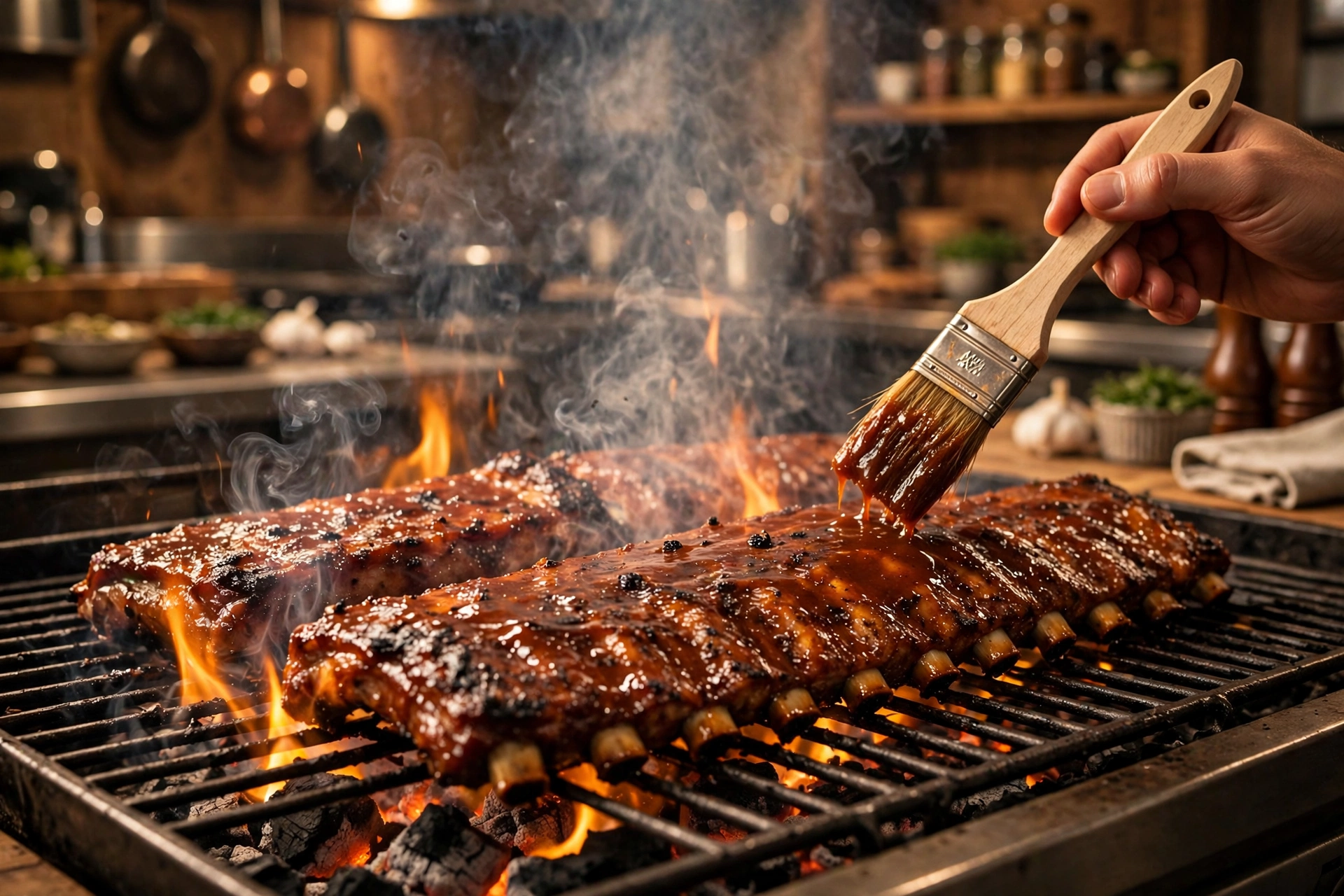
On the grill, the ribs are turned and basted with Texas Roadhouse’s barbecue sauce. The Takeout’s account of the KTTC demonstration puts the grill time at eight minutes, with the ribs turned slowly and basted as they go. Chowhound describes it as two minutes per side on a 450°F grill. Those two accounts are not necessarily contradictory — eight minutes total with turning, versus two minutes per side on a very hot grill, describe a similar finish — but the exact grill time is not something the chain publishes, so treat both as reported descriptions of the same step. What every source agrees on is the purpose: the grill develops crisscrossed char marks, firms up the seasoned exterior, adds smokiness, and caramelizes the barbecue sauce into a sticky, glistening glaze.
The sauce itself is the chain’s own barbecue sauce, described by sources as rich, punchy, and sweet-savory. It is applied on the grill rather than before the slow cook, which is why it stays bright and glossy instead of burning or drying out during the long oven time. The result is the plate people picture when they think of Texas Roadhouse ribs: dark char lines, a sticky sauce crust, and meat that falls off the bone.
What Cut of Ribs Does Texas Roadhouse Use?
Texas Roadhouse uses pork baby back ribs, also called pork loin back ribs. That is confirmed across sources, including the chain’s own materials and the chef demonstration. Baby backs are smaller and leaner than spare ribs or St. Louis-style ribs, with a natural curve and meat between the bones that pulls cleanly away when cooked low and slow. Some secondary sources mention St. Louis-style ribs as well, but the chef demonstration and the most detailed reporting agree on baby backs, and the chain’s menu describes the dish as “fall-off-the-bone” ribs without specifying a second cut.
The “fall-off-the-bone” name is not marketing exaggeration — it is the literal standard the cooking method is built around. In competition barbecue, ribs that fall off the bone are actually considered overcooked, because a judge wants a clean bite that leaves the bone with a little tug. At Texas Roadhouse, the goal is the opposite: the meat should slide off the bone without a knife, and the 10-hour cook is designed to deliver exactly that. If you prefer ribs with a bit of chew, this is not the plate for you — and that is useful to know before you order.
Half Rack vs Full Rack: What to Order
Texas Roadhouse serves its ribs as a half rack or a full rack, both with two made-from-scratch sides and unlimited rolls. The full rack is the whole slab; the half rack is half of one. Both go through the same three-step process, and both are finished on the grill to order. The half rack is the right choice if you want ribs as part of a bigger meal or if you are pairing them with something else — the Chicken Critters with Ribs combo, for example, pairs a half rack with the tenders, and our guide to texas roadhouse chicken critters covers that combination and its reported prices.
The ribs also appear on the Early Dine menu at some locations, where a half rack has been reported as one of the rotating early bird entrées. Availability varies — the early bird list is set location by location — so confirm with your server if you are visiting in the early bird window. Our guide to the Texas Roadhouse early bird covers the full list and the conflicting hours. As for price, we are not stating a rib price here, because the guides we checked did not converge on a single reported figure for the standalone rack and we do not invent prices. The combo prices reported in recent guides — roughly $21.99 to $24.99 for Chicken Critters with Ribs — give a rough sense of the range, but check your location’s menu board or the app for the current price of the rack itself.
How Texas Roadhouse Ribs Compare to LongHorn’s Ribs
The natural comparison is LongHorn Steakhouse, the other big steakhouse chain with a famous rib plate. Both chains start with pork baby back ribs and both use a combination of baking and grilling, but the methods differ in time and temperature. Texas Roadhouse cooks low and slow for about 10 hours at 200°F; LongHorn cooks on higher heat for a shorter time, according to The Takeout’s comparison. Texas Roadhouse uses its own in-house rib seasoning, which is sold in stores; LongHorn uses its own unspecified blend. The result is a difference in texture: Texas Roadhouse ribs are built to fall off the bone, while LongHorn’s are generally described as tender with a little more bite. Neither is objectively better — it depends on whether you want meat that slides off the bone or meat that holds together until you bite it.
The comparison also shows up in the sauce. Texas Roadhouse finishes its ribs with its own barbecue sauce basted on the grill, giving a sweet-savory glaze. LongHorn finishes its ribs differently, and its rib plate is usually described with its own sauce profile. If you are choosing between the two chains for ribs specifically, the honest advice is to decide on texture first: fall-off-the-bone means Texas Roadhouse; a firmer bite means LongHorn.
How to Copy Texas Roadhouse Ribs at Home
You can copy the Texas Roadhouse method at home with an oven, a grill, and patience. This is a copycat method based on the confirmed three steps — it is not the restaurant’s recipe, which is proprietary — but it follows the same logic: dry rub, long slow cook with moisture underneath, and a short hot grill finish with sauce.
1. Prep the rack. Start with a rack of pork baby back ribs. Slide a butter knife under the membrane on the bone side, grip it with a paper towel, and pull it off completely. Pat the ribs dry. If you can buy Texas Roadhouse Rib Seasoning, use it; otherwise, mix a rub from salt, pepper, paprika, garlic powder, and onion salt with a little brown sugar — the same family of flavors the chef demonstration lists.
2. Season heavily on both sides. Coat the ribs liberally with the rub on one side, flip, and coat the other side just as heavily. Press the rub in lightly so it sticks. Let the seasoned ribs rest while the oven preheats to 200°F — or up to 275°F if you are short on time, though the lower temperature and longer cook is closer to the restaurant method.
3. Set up the low-and-slow cook. Place a wire rack inside a roasting pan. Pour about half a cup of water and two tablespoons of liquid smoke underneath the rack — the same setup the chef demonstration describes. Lay the ribs on the rack, meat side up, cover the pan tightly with foil, and cook at 200°F for about 10 hours, or at 275°F for about 2.5 to 3 hours if you are using the higher-temperature shortcut. The ribs are done when the meat has pulled back from the bones and a gentle tug separates it easily.
4. Rest, then grill. Let the ribs rest for 10 to 15 minutes after they come out of the oven. Heat your grill to high — around 450°F if you can measure it. Place the ribs on the grill for about two minutes per side, brushing generously with your favorite barbecue sauce as they cook, until the sauce is caramelized and bubbly and the rub has developed char marks. Do not walk away: the sugar in the sauce burns fast.
5. Slice and serve. Cut between the bones, serve with two sides, and put honey cinnamon butter rolls on the table if you really want the full Texas Roadhouse feeling. The most common home-cook mistake is rushing the slow cook — three to four hours at low heat gives chewy ribs, not tender ones. If you want the fall-off-the-bone result, give it the full time.
Frequently Asked Questions About How Texas Roadhouse Cooks Ribs
How does Texas Roadhouse cook its ribs?
Texas Roadhouse cooks ribs in three steps: the racks are coated with the chain’s rib seasoning, slow-cooked low and slow at about 200°F for roughly 10 hours, and then finished on a hot grill for a few minutes, basted with barbecue sauce, when a guest orders them.
How long does Texas Roadhouse cook its ribs?
The oven cook is about 10 hours at 200°F, according to a Texas Roadhouse chef speaking to a Minnesota news station. Some sources describe a three-day preparation process, which most likely covers the full cycle of seasoning, cooking, resting, and staging — not 72 hours in the oven.
What temperature does Texas Roadhouse cook ribs at?
About 200°F for the slow cook, per the chef’s account. The grill finish is much hotter — reported at around 450°F for about two minutes per side.
Are Texas Roadhouse ribs beef or pork?
Pork. Texas Roadhouse uses pork baby back ribs, also called pork loin back ribs. They are not beef ribs and not spare ribs.
What seasoning does Texas Roadhouse use on ribs?
The chain’s own in-house rib seasoning, a dry rub that includes salt, pepper, paprika, garlic powder, and onion salt, according to a chef demonstration. The full blend is proprietary, and the seasoning is sold in stores.
Why are Texas Roadhouse ribs so tender?
The long, low cook melts collagen into gelatin and renders fat slowly, which makes the meat succulent and lets it slide off the bone. The foil-covered pan and the water underneath keep the meat moist through the 10-hour cook.
Does Texas Roadhouse smoke its ribs?
Not in a smoker, according to the chef demonstration. The smoky flavor comes from liquid smoke in the water under the rack during the slow cook, plus the char and smoke from the grill finish.
Are Texas Roadhouse ribs grilled or baked?
Both. They are slow-cooked in the oven first, then finished on the grill to order. The oven does the tenderizing; the grill adds char, smoke, and the caramelized sauce finish.
Can you get a half rack of ribs at Texas Roadhouse?
Yes. Ribs are served as a half rack or a full rack, both with two sides and rolls. A half rack also appears in the Chicken Critters with Ribs combo.
How can I make Texas Roadhouse-style ribs at home?
Season baby back ribs generously with a paprika-based dry rub, cook them on a rack over water and liquid smoke, covered with foil, at 200°F for about 10 hours (or 275°F for 2.5 to 3 hours as a shortcut), then grill for about two minutes per side, basting with barbecue sauce until caramelized.