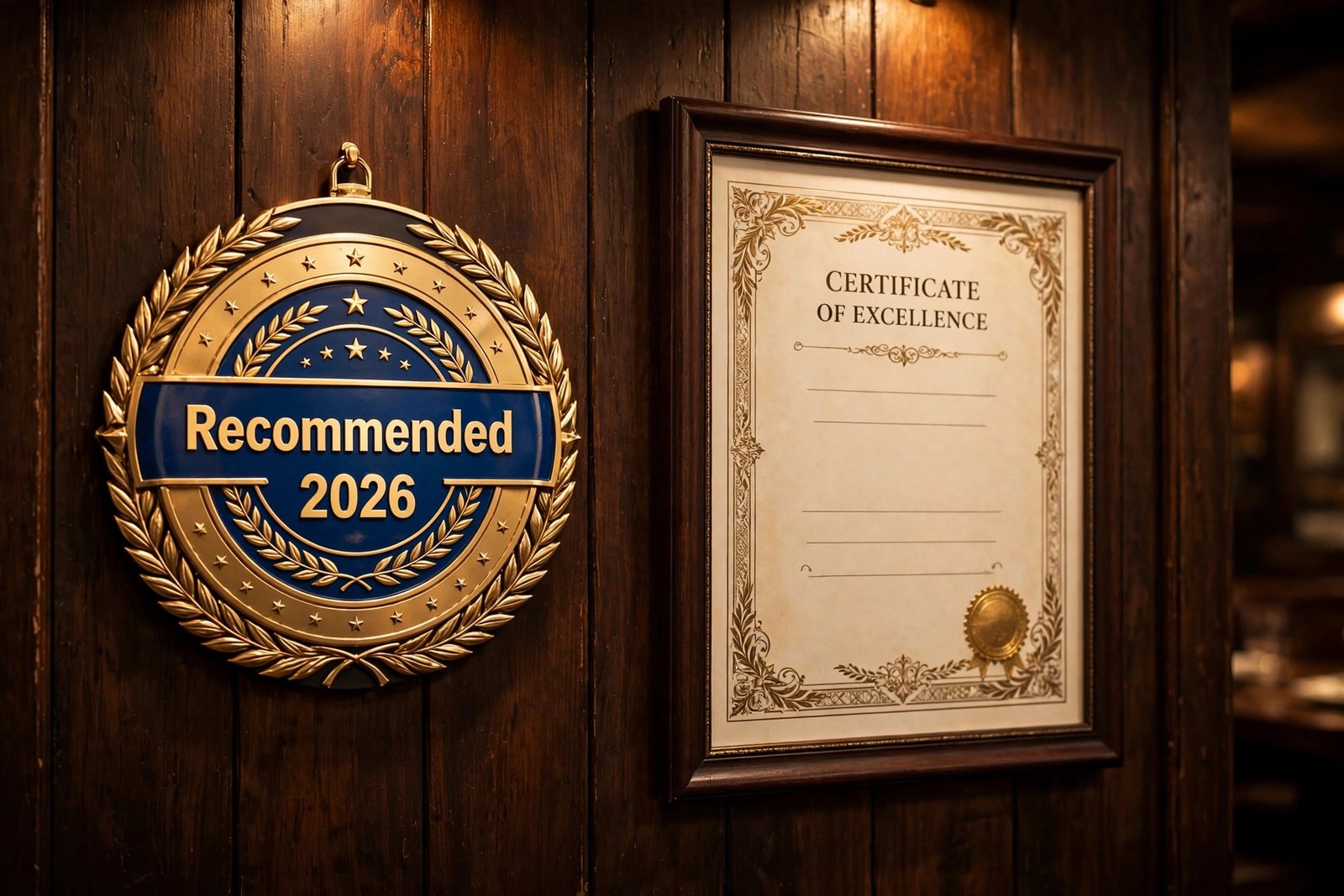
You have probably seen one stuck to a restaurant window or pasted on a pizzeria’s website: a shiny badge that says “Restaurant Guru Recommended” or “Certificate of Excellence”, sometimes with a year like 2025 stamped on it. It looks official — like a Michelin star or a health inspection grade. So what does it actually mean, and how does a restaurant earn one?
In short: the Restaurant Guru award is an automated, algorithm-driven recognition. Restaurants don’t apply, pay, or get inspected to receive it. Instead, Restaurant Guru’s system scans public ratings from Google, Yelp, TripAdvisor, Foursquare, and Zomato, and any restaurant whose weighted average clears the platform’s threshold — industry analysis puts it at roughly 4.7 stars — gets the badge automatically. Here’s everything diners and restaurant owners should know about how it works.
What Is Restaurant Guru?
Restaurant Guru (restaurantguru.com) is a global restaurant discovery platform founded in 2013. It is not a review site in the usual sense — it doesn’t collect its own diner reviews the way Yelp or TripAdvisor do. Instead, it functions as a meta-aggregator: it pulls ratings from five major review platforms — Google, Yelp, TripAdvisor, Foursquare, and Zomato — and combines them into a single consensus score for each restaurant.
The scale is enormous. Industry analyses of the platform put its footprint at roughly 20 million indexed restaurants across about 190 countries, with around 30 million monthly users. For comparison, that’s far wider geographically than Michelin (which inspects a small number of cities) but far shallower in terms of editorial judgment — there are no critics, no inspectors, and no human editorial board involved in deciding who gets an award.
What Does the Restaurant Guru Award Actually Mean?
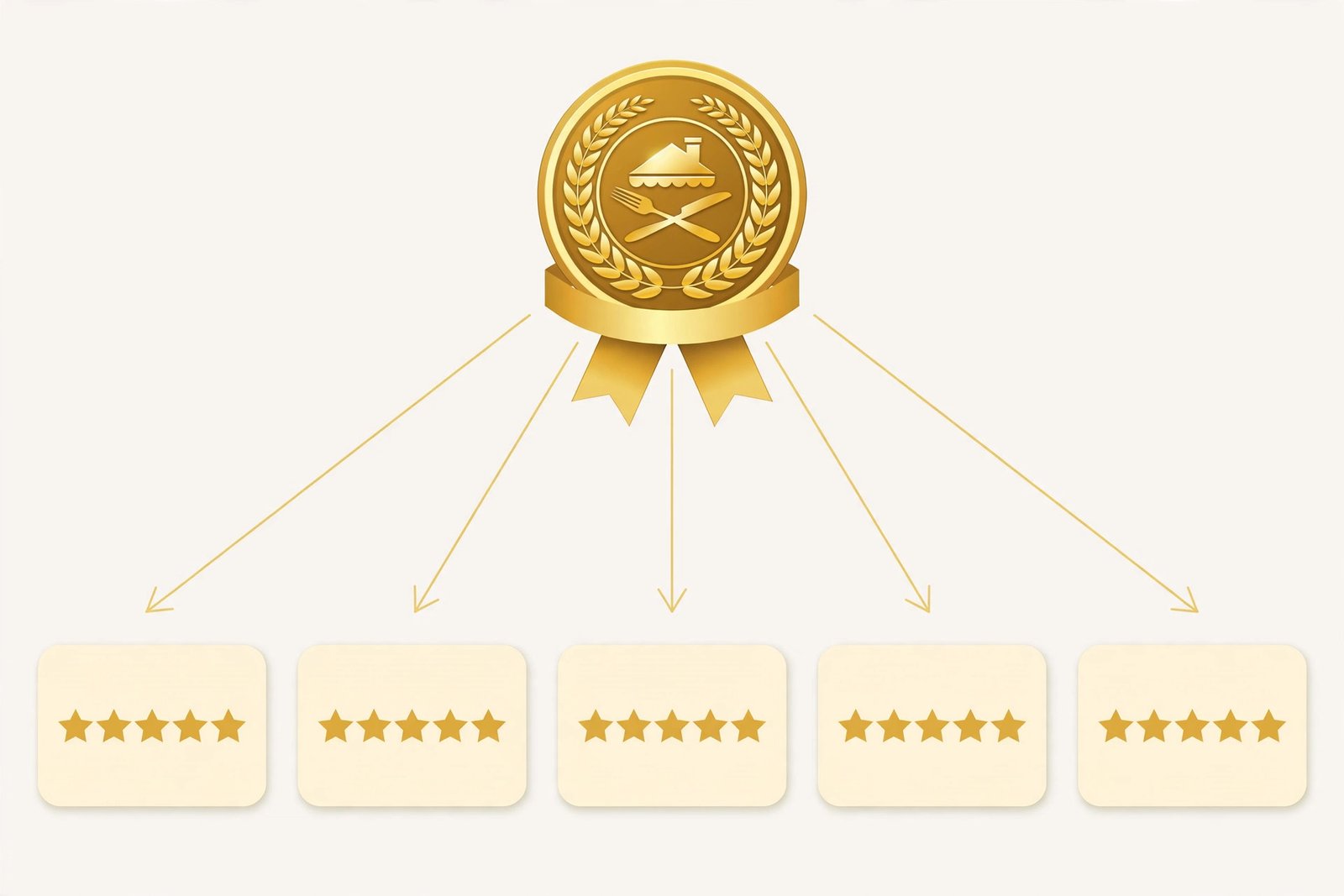
When you see “Restaurant Guru Recommended” or “Restaurant Guru Certificate of Excellence” on a restaurant’s window, menu, or website, it means the restaurant’s weighted average rating across the five monitored review platforms cleared Restaurant Guru’s quality threshold.
Restaurant Guru doesn’t publish its exact formula, but independent analyses that studied thousands of awarded restaurants consistently estimate the functional cutoff at approximately 4.7 stars. Key details:
- It’s a weighted average, not a simple one. Platforms with larger review volume and more recent activity (usually Google and Yelp in the US) appear to carry more weight than smaller ones. A restaurant that’s strong everywhere passes; one that’s excellent on a single platform but mediocre on Google usually doesn’t.
- Consistency matters more than peaks. A steady 4.7–4.8 across Google, Yelp, and TripAdvisor earns the badge more reliably than a perfect 5.0 on Foursquare paired with 4.3 on Google.
- It’s issued by year. Badges are labeled by year (e.g., “Recommended 2025”), since the score is based on current review data, not a one-time lifetime achievement.
What the Badge Does NOT Mean
This is where most diners misread the signal. The Restaurant Guru badge does not mean:
- An expert inspected the restaurant. No chef, critic, or inspector visited. It’s pure math on public review data.
- The restaurant paid for the award. There is no application fee and no pay-to-win channel. The badge itself is free and automated.
- It passed specific quality standards. There are no criteria for food safety, sourcing, or service technique. The algorithm measures aggregate satisfaction, not culinary merit.
- It’s better than a non-badged rival. A fantastic neighborhood spot with strong ratings on only two platforms may have no badge, while a solid but unremarkable chain with 4.7s everywhere gets one. The badge rewards breadth of consensus, not depth of excellence.
Think of it as a useful statistical summary: “a lot of people, on a lot of platforms, liked this place.” That’s a reasonable first filter when you’re picking a restaurant in an unfamiliar city — just don’t confuse it with an expert recommendation. Our guide on whether LongHorn Steakhouse is actually good shows what an honest, detailed restaurant review looks like by comparison.
How Restaurants Get the Restaurant Guru Award
There is no application process. Here is how it actually happens, step by step:
- The restaurant builds strong public ratings. Owners can’t control the algorithm directly — the input is their Google, Yelp, TripAdvisor, Foursquare, and Zomato scores, which come from real diners.
- Restaurant Guru’s system runs continuously. When a restaurant’s weighted aggregate crosses the threshold, the system flags it automatically.
- An automated email goes out. Restaurant Guru notifies the business — usually using contact details from its Google Business Profile or other public listings — that it has earned the “Recommended” status.
- The restaurant claims it. The owner can download the digital badge to display online, and optionally purchase physical materials: printable certificates, window stickers, and award plaques. The award itself costs nothing; only the optional display materials do.
One honest caveat worth knowing: many restaurant owners report that the congratulatory email is followed by persistent marketing for those paid plaques and premium listings. Restaurant Guru’s Trustpilot score sits around 3.5 out of 5 (about 156 reviews), with complaints centering on aggressive email campaigns and the platform’s opaque methodology — not on fake data. The ratings behind the award are real; the sales funnel around it is what draws criticism.
Certificate of Excellence vs. Recommended Badge
You may see both wordings. They’re two names for the same program: “Certificate of Excellence” is the text on the award certificate, while “Recommended” is the branding used on the digital badge and window stickers. Both trace back to the same review-based threshold, and both are re-issued by year as the restaurant’s scores evolve. A “Certificate of Excellence 2025” and a “Recommended 2025” badge on the same door are the same award, not two separate honors.
Restaurant Guru vs. Michelin, Yelp, and Google Reviews
| Award/System | Who Decides | Coverage | What It Measures |
|---|---|---|---|
| Restaurant Guru Recommended | Algorithm (5 platforms) | ~190 countries | Cross-platform review consensus |
| Michelin stars | Anonymous human inspectors | Selected cities/countries | Food quality, mastery, consistency |
| Yelp/Google ratings | Individual diners | Global | Single-platform crowd opinion |
| James Beard Awards | Industry judges | United States | Peer-judged culinary excellence |
The Guru badge sits in a unique slot: broader than any critic, narrower in meaning than any single review. It’s best used as a fast baseline filter — “is this place at least widely liked?” — before you dig into actual reviews for the details that matter to you: which dishes, which prices, which vibe.
Frequently Asked Questions
What is the meaning of a Restaurant Guru award?
It means a restaurant achieved a weighted average rating of roughly 4.7 stars or higher across Google, Yelp, TripAdvisor, Foursquare, and Zomato, as calculated by Restaurant Guru’s aggregation algorithm. It certifies broad diner consensus, not an expert’s endorsement.
What is a Restaurant Guru Certificate of Excellence?
It’s the same program as the “Recommended” badge — “Certificate of Excellence” is the wording printed on the award certificate, while “Recommended” appears on the digital badge and window stickers. Both are issued by year and based on the same review threshold.
How do restaurants get a Restaurant Guru award?
They don’t apply. The award is automatic: when a restaurant’s aggregated ratings across the five monitored platforms cross the quality threshold, Restaurant Guru’s system detects it and sends an automated notification email to the business.
Do restaurants have to pay for the Restaurant Guru award?
No. The award itself is free and automatic — there is no application fee and no paid path to earning the badge. Restaurants can optionally buy physical display materials (plaques, window stickers) or premium listings, but those are marketing add-ons, not the award.
Is the Restaurant Guru award legit?
The data behind it is real — it’s based on actual public reviews from five major platforms, and the company has operated since 2013 with tens of millions of monthly users. It’s not a scam. But it’s an algorithmic consensus score, not an expert review, and the company’s aggressive marketing emails to restaurants have drawn complaints (roughly 3.5/5 on Trustpilot).
What is the Restaurant Guru rating threshold?
Restaurant Guru doesn’t publish the exact formula, but independent analyses of awarded restaurants consistently estimate the functional threshold at about 4.7 weighted stars across the five source platforms, with higher-volume and more recent platforms carrying more weight.
Is a Restaurant Guru award the same as a Michelin star?
No. Michelin stars come from anonymous professional inspectors judging food quality in a small number of cities. The Restaurant Guru badge is an automated statistical summary of public review scores across ~190 countries. They measure completely different things.
How can I check if a restaurant has a Restaurant Guru award?
Search the restaurant’s name plus “restaurant guru” on Google, or look up the restaurant directly on restaurantguru.com. Awarded restaurants usually display the badge or certificate on their website, social profiles, or window — check that it carries a recent year.
Do Restaurant Guru awards expire?
They’re issued by year (e.g., Recommended 2025), and a restaurant’s status depends on its current aggregated scores. If ratings slip below the threshold, the badge won’t be re-issued for the following year — so an old sticker on a window doesn’t guarantee current quality.
Should I trust a Restaurant Guru Recommended badge when choosing a restaurant?
Treat it as a first filter, not a verdict. It reliably means the restaurant is widely liked across multiple platforms — useful for ruling out bad options in an unfamiliar city. For a great choice, still read actual recent reviews and check the menu before you go.
The Bottom Line
The Restaurant Guru award means a restaurant has earned consistently strong reviews across Google, Yelp, TripAdvisor, Foursquare, and Zomato — enough to clear roughly a 4.7-star weighted threshold. It costs the restaurant nothing, no one inspects the kitchen, and the badge is issued by year. Used as a quick consensus filter, it’s genuinely useful; mistaken for a critic’s endorsement, it overpromises. When in doubt, read the actual reviews — and check the menu.
Related: Is LongHorn Steakhouse Good? Honest Review · LongHorn Steakhouse Menu With Prices (2026) · LongHorn Near Me: Phone, Reservations & Waitlist